

How to Choose the Right Credit Cards for Your Spending Habits
Americans earned a staggering $47 billion in credit card rewards in 2024, yet billions went unredeemed and the average cardholder earned just 1.6 cents per dollar spent. The gap between what you could earn and what you actually earn usually comes down to one thing: using the wrong card at the wrong merchant. This guide walks you through a practical, data-driven process for matching your real spending patterns to the cards that maximize your rewards. Whether you favor cash back, travel points, or a hybrid approach, you will leave with a clear action plan and the tools to execute it.
Why Card Choice Matters More Than You Think
Credit card rewards are not free money. They are funded by interchange fees merchants pay on every swipe. But if you are not strategic, most of that value goes unclaimed. According to the CFPB via The Motley Fool, Americans redeemed only $43 billion of the $47 billion they earned in 2024, and 2.8% of rewards were forfeited that quarter alone.
A LendingTree survey found that nearly 70% of rewards cardholders are sitting on unused cash back, points, or miles. The root cause is not laziness; it is complexity. With hundreds of cards on the market, choosing the right two or three for your wallet requires a system.
Step 1: Audit Your Actual Spending
Before comparing cards, you need a clear picture of where your money goes. Pull three to six months of bank and credit card statements and sort transactions into categories: groceries, dining, gas, travel, online shopping, subscriptions, and everything else.
Use Read-Only Bank Connections
Manually tagging transactions is tedious. Services like Savvx connect to your accounts through Plaid in read-only mode and automatically categorize your spending against a catalog of 343 credit cards. This gives you an accurate baseline without the spreadsheet headache.
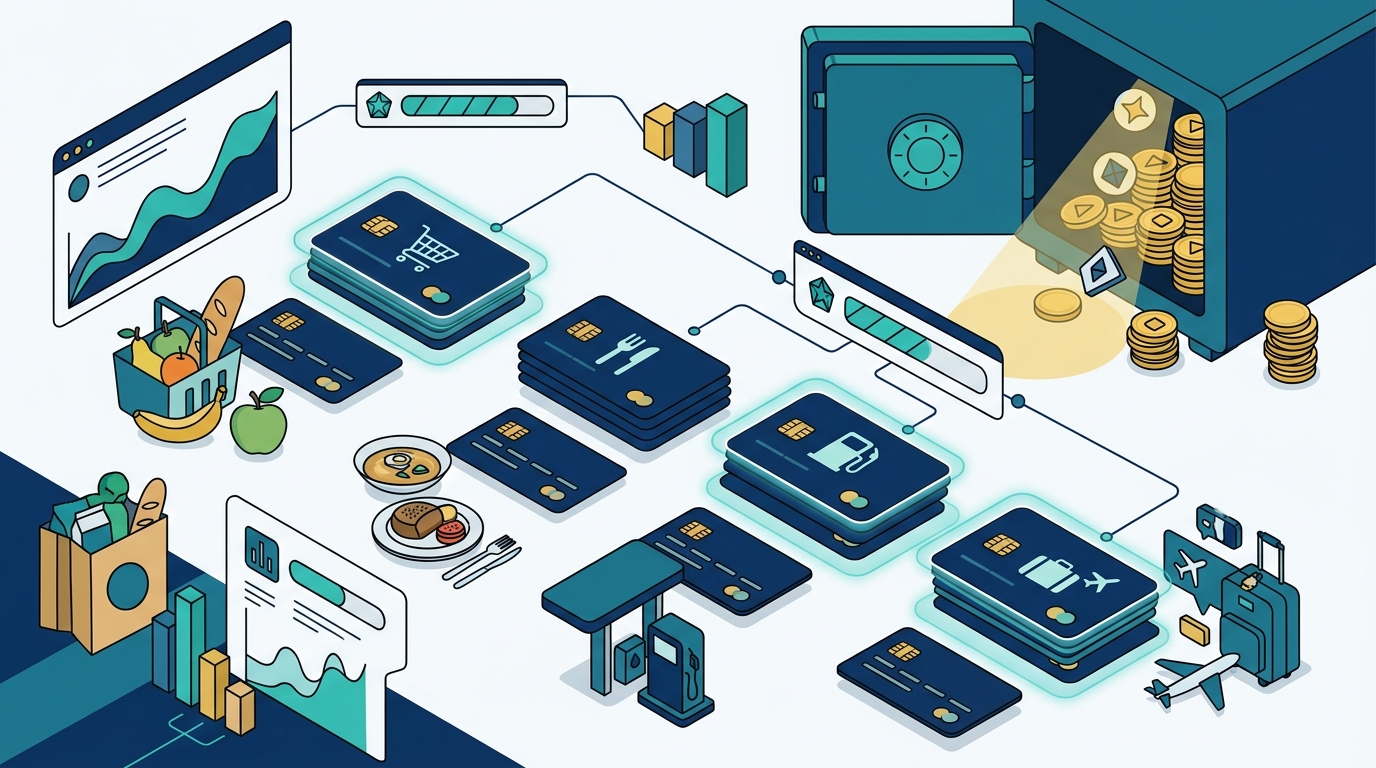
Identify Your Top Three Categories
Most households find that 60% or more of card-eligible spending concentrates in just two or three categories. A typical U.S. household can put roughly $33,000 per year on credit cards, according to CreditCards.com analysis of BLS data. Knowing your top categories tells you exactly which bonus multipliers to target.
Step 2: Understand Reward Types
Cash back is a percentage of each purchase returned as a statement credit or deposit. Points are a loyalty currency whose value varies based on how you redeem them. Miles are points branded by an airline or hotel program that can be transferred to travel partners for outsized value.
Points Valuation Is Not One-Size-Fits-All
Headline valuations you see on review sites (e.g., "Chase points are worth 2 cents each") assume you redeem through specific transfer partners at peak rates. Your actual value depends on how and where you travel. Savvx models point values based on your personal travel patterns, not generic portal rates, so the recommendation reflects your reality.
Step 3: Compare Cards Against Your Categories
Once you know your top spending categories and your preferred reward type, compare card options head to head. The table below illustrates how different card archetypes perform on a hypothetical $33,000 annual spend split across common categories.
| Card Type | Groceries (5k) | Dining (4k) | Gas (2k) | Travel (3k) | Other (19k) | Est. Annual Rewards |
|---|---|---|---|---|---|---|
| Flat 2% Cash Back | $100 | $80 | $40 | $60 | $380 | $660 |
| Rotating 5% Categories | $250* | $80 | $100* | $60 | $190 | $680 |
| Premium Travel Card ($550 AF) | $50 | $120 | $20 | $150 | $190 | $530 net** |
| Optimized 2-3 Card Combo | $300 | $160 | $100 | $150 | $380 | $1,090+ |
*Subject to quarterly caps. **After subtracting annual fee and applying statement credits.
The optimized combo row shows why holding two or three complementary cards, and knowing which one to pull out at each register, can nearly double your return versus a single flat-rate card. That is where a tool like the Savvx card optimizer delivers its value: it tells you which card to use at each merchant in real time.
Step 4: Run the Annual-Fee Math
An annual fee is the yearly charge a card issuer collects for premium benefits. The CFPB reports that the average annual fee on a consumer credit card was $127 in 2024. That fee is only worth paying if the incremental rewards and perks exceed the cost.
Factor in Hidden Credits
Many premium cards bundle statement credits for dining, streaming, or airline incidentals. These credits can offset $200 to $400 of a headline fee if you use them. Savvx tracks which annual-fee credits you are leaving on the table and alerts you before they expire, turning a seemingly expensive card into a net positive.
Know When to Downgrade
If a card's net value dips below zero, downgrading to a no-fee version preserves your credit history and points balance. The right time to evaluate is 30 to 60 days before your renewal date.
Step 5: Automate Your Card Optimization
Manual tracking works for a while, but life gets busy. Automation is the difference between knowing the theory and actually capturing the rewards. Savvx analyzes your real spending against 130+ transfer partners and surfaces concrete actions: which card to swipe at which merchant, which sign-up bonus you are closest to earning, and when an issuer devalues a program you hold.
Because Savvx's only revenue is your subscription fee, the recommendations are never skewed by affiliate commissions or card-issuer kickbacks. That is a critical distinction in an industry where most "best card" lists are monetized through referral links.
Key Takeaways
- Americans earned $47 billion in credit card rewards in 2024, but nearly 70% of cardholders have unused rewards sitting idle.
- Audit three to six months of real spending before choosing any new card.
- A two- or three-card combo matched to your top spending categories can nearly double your return versus a single flat-rate card.
- Points and miles valuations depend on your personal travel habits, not headline rates.
- Annual fees are worth paying only when net rewards plus credits exceed the cost.
- Automating card selection at the merchant level closes the gap between strategy and execution.
- Subscription-only tools like Savvx remove the affiliate bias that plagues most card recommendation sites.
Frequently Asked Questions
How many credit cards should I carry?
Most optimizers find that two to three cards cover 90% of bonus categories. The average U.S. adult already holds about three credit cards, according to CFPB data reported by NerdWallet. The goal is not more cards; it is the right cards for your spending.
Is cash back or points better?
Cash back is simpler and its value is fixed. Points can be worth significantly more if you transfer them to airline or hotel partners, but only if you actually travel. Choose based on how you redeem, not on the theoretical maximum.
Do annual fees ever pay for themselves?
Yes, but only if you use the bundled credits and your spending generates enough incremental rewards. Run the math: subtract the fee from total rewards plus credits. If the number is positive, the card is worth keeping.
How does Savvx differ from free card recommendation sites?
Free sites earn revenue from affiliate links and issuer partnerships, which can bias which cards appear at the top. Savvx charges a subscription and earns zero from card companies, so its recommendations optimize purely for your rewards math.
Is it safe to connect my bank accounts?
Savvx uses Plaid for read-only access. Plaid is the same infrastructure used by thousands of financial apps. Your credentials are never stored by Savvx, and the connection cannot initiate transactions. See the Savvx privacy policy for details.
How often should I re-evaluate my card lineup?
At least once a year, or whenever your spending habits shift significantly (new job, relocation, new baby). Card issuers also change bonus categories and devalue programs periodically, so ongoing monitoring helps.
What if I carry a balance?
If you carry a balance, the interest you pay almost always outweighs the rewards you earn. The average credit card APR was roughly 21% in early 2026. Prioritize paying down debt before optimizing rewards.
Can I optimize without signing up for new cards?
Absolutely. Card optimization starts with using the cards you already own at the right merchants. You may discover your existing wallet is underperforming simply because you default to one card for everything.
Start Maximizing Your Rewards Today
Stop guessing which card to swipe. Try Savvx to see exactly how much you are leaving on the table and get personalized, bias-free card recommendations built on your real spending data.