

Managing money used to mean spreadsheets, manual tracking, and guesswork. In 2026, automation has changed the equation. AI-powered tools now analyze your spending, optimize your credit card rewards, forecast cash flow, and flag opportunities you would otherwise miss. Whether you want to stop leaving rewards on the table or build a hands-off financial system, the answer to "Can I automate my financial analysis and planning?" is a resounding yes. This guide walks you through what automation looks like today, how it works, and where to start.
What Is Automated Financial Analysis?
Automated financial analysis is the use of software and AI to collect, categorize, and interpret your financial data without manual effort. Instead of combing through bank statements yourself, an automated system ingests transactions, identifies patterns, and delivers actionable insights.
What started as simple transaction categorization has evolved into sophisticated guidance systems. Modern AI tools can analyze spending patterns, suggest savings opportunities, and even help manage investments. The shift from passive tracking to active recommendation is what separates 2026-era tools from legacy apps.
Why Automation Matters More Than Ever
Financial lives have become fragmented. Spending lives in one app, investments in another, and credit card rewards in yet another. This fragmentation creates blind spots that cost real money.
Research from Gartner found that only 15% of FP&A leaders reported having a sustainable delivery model for their teams. While that stat targets enterprise teams, the principle applies to individuals: manual processes do not scale. Meanwhile, automated data processing has been shown to cut manual errors by roughly 50%, boosting accuracy in any financial workflow.
The Cost of Doing Nothing
Every month you swipe the wrong credit card at the grocery store or forget to use an annual-fee credit, you leave money on the table. Automation eliminates that drag by continuously monitoring your accounts and surfacing the right action at the right time.
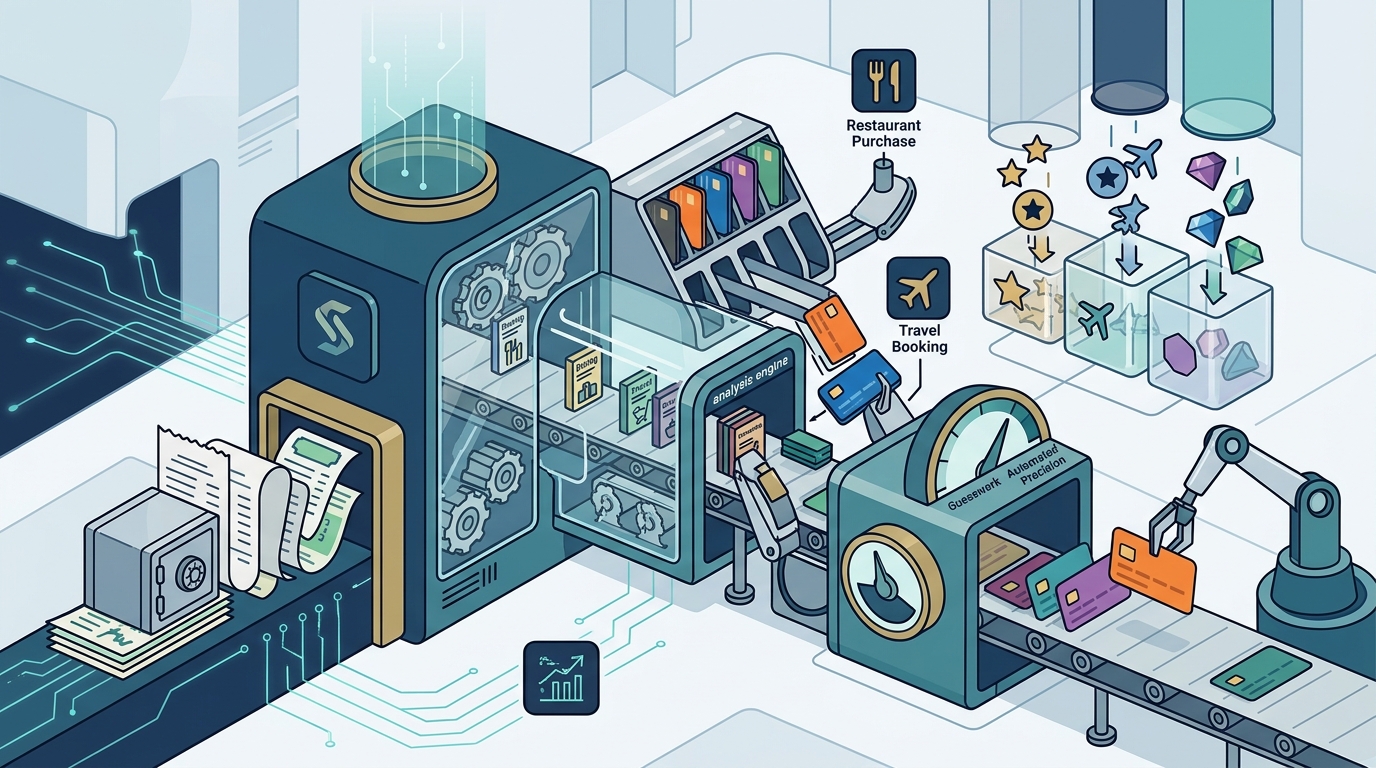
What You Can Actually Automate Today
The scope of personal financial automation in 2026 is broader than most people realize. Here is a breakdown of what modern tools handle:
| Task | Manual Approach | Automated Approach |
|---|---|---|
| Spending categorization | Export CSV, tag in spreadsheet | Real-time auto-categorization via bank feed |
| Credit card selection per purchase | Memorize bonus categories | AI recommends optimal card per merchant |
| Sign-up bonus tracking | Calendar reminders, spreadsheet | Progress tracking with alerts |
| Annual fee credit usage | Remember deadlines manually | Automated reminders before expiry |
| Points valuation | Check blogs, estimate | Model true value based on your travel patterns |
| Card keep/close decisions | Gut feeling | Net-value calculation per card per year |
Beyond Budgeting
Traditional tools stop at budgeting. The next generation of automation looks forward: forecasting cash flow, flagging program devaluations, and modeling which new card would add the most value to your wallet based on your real spending history.
How Secure Bank Connections Power Automation
Plaid is a fintech infrastructure company that acts as a secure bridge between your bank and financial apps. It uses AES-256 encryption and Transport Layer Security (TLS) to keep data safe end to end. Once authenticated, Plaid creates a secure token that grants read-only access to the specific data an app needs, such as balances and transactions, without ever exposing your password.
Over 12,000 financial institutions connect through Plaid, and roughly one in two U.S. adults has used it to link an account. The company is certified under ISO 27001 and ISO 27701, and its API undergoes regular independent security audits.
What Read-Only Means for You
Read-only access is exactly what it sounds like: the connected app can see your transactions and balances but cannot move money, open accounts, or make changes. Services like Savvx use this read-only connection through Plaid so your data flows in for analysis while your accounts remain untouched.
Automating Credit Card Optimization
Credit card optimization is the process of matching every purchase to the card that earns the highest reward for that specific merchant or category. With hundreds of cards on the market and constantly shifting bonus structures, doing this manually is nearly impossible.
Savvx solves this by analyzing your real spending against a curated catalog of 343 cards and over 130 transfer partners. It models the true value of your points based on how you actually travel, not inflated portal redemption rates. The result is a clear, per-merchant recommendation: which card to swipe, which sign-up bonus you are closest to hitting, and which annual-fee credits you have not yet used.
Why Bias-Free Advice Matters
Most card recommendation sites earn affiliate commissions from issuers. That business model creates an incentive to recommend the card that pays the site the most, not the card that earns you the most. Savvx operates on a subscription-only model with no affiliate links, no card-issuer kickbacks, and no ads. Your subscription is the only revenue, which means recommendations optimize for your rewards math alone.
Choosing the Right Automation Tool
Not every tool is built to reason across your entire financial picture. Here is what to evaluate:
| Criterion | What to Look For |
|---|---|
| Data source | Does it connect to your real accounts via a secure provider like Plaid? |
| Revenue model | Subscription-only means unbiased advice; affiliate revenue may skew recommendations |
| Scope | Does it cover card optimization, sign-up bonuses, annual-fee credits, and program devaluations? |
| Personalization | Does it model value based on your travel patterns and spending, not averages? |
| Actionability | Does it tell you what to do next, not just show you data? |
Tools that focus narrowly on budgeting or expense tracking are helpful but incomplete. For credit card holders with multiple cards, a dedicated rewards optimization service closes the gap between tracking and earning.
Key Takeaways
- Yes, you can automate most of your financial analysis and planning in 2026 using AI-powered tools.
- Automated financial analysis is the use of software to collect, categorize, and interpret your financial data without manual effort.
- Secure bank connections through Plaid use AES-256 encryption, TLS, and read-only tokens to keep your accounts safe.
- Credit card optimization is the process of matching every purchase to the highest-reward card for that merchant or category.
- Subscription-only business models, like the one at Savvx, eliminate affiliate bias from card recommendations.
- Savvx analyzes 343 cards and 130+ transfer partners against your actual spending to surface concrete next actions.
- Automation reduces errors, saves time, and catches opportunities like unused annual-fee credits and approaching sign-up bonus thresholds.
Frequently Asked Questions
Can I really automate my financial analysis without a financial advisor?
Yes. AI-powered platforms now handle spending analysis, card optimization, and cash flow forecasting that previously required manual work or professional help. For credit card rewards specifically, tools like Savvx provide personalized, data-driven recommendations automatically.
Is it safe to connect my bank account to a financial app?
When apps use Plaid, your credentials are never shared with the app itself. Plaid creates a read-only token and encrypts all data with AES-256 and TLS. The company holds ISO 27001 and ISO 27701 certifications and undergoes regular third-party audits.
How does Savvx differ from free card recommendation sites?
Free sites typically earn affiliate commissions from card issuers, which can bias their recommendations. Savvx earns revenue only from your subscription fee, so every recommendation optimizes for your rewards, not issuer payouts.
What exactly does credit card optimization automate?
It automates which card to use at each merchant, tracks sign-up bonus progress, alerts you to unused annual-fee credits, flags program devaluations, and calculates the real net value of keeping versus closing each card.
Do I need technical skills to set up automated financial tools?
No. Most modern tools connect through Plaid in seconds. You log in to your bank through a secure widget, grant read-only permission, and the tool handles the rest.
How many credit cards does Savvx analyze?
Savvx maintains a curated catalog of 343 cards and over 130 transfer partners, modeling the true value of points based on your personal travel and spending patterns.
Will automation replace human financial advisors entirely?
Not for every scenario. Complex situations like estate planning or tax strategy may still benefit from human expertise. However, for day-to-day spending optimization and credit card rewards, automation now delivers faster, more consistent results than manual methods.
Start Maximizing Your Rewards Automatically
Stop guessing which card to swipe. Connect your accounts on Savvx and let AI analyze your real spending against 343 cards to find the rewards you are leaving on the table. Your subscription is the only revenue, so every recommendation is built for you, not a card issuer.