

No single credit card earns top rewards on every purchase. A credit card combination is a set of two to four complementary cards that, used together, capture the highest possible return across all your spending categories. The strategy is straightforward: pair a card with strong bonus categories alongside a flat-rate card for everything else, then pool the points into one flexible currency. In this guide, we break down the most popular card ecosystems, show you exactly how to build your own combo, and explain how tools like Savvx can automate the whole process using your real spending data.
Why One Card Is Never Enough
The average American household leaves between $800 and $1,200 in rewards on the table each year by relying on a single card, according to recent industry estimates. The reason is simple: one card might offer 4x on dining but only 1x on groceries, while another dominates gas purchases but falls flat on travel.
A strategic pairing solves this by layering bonus categories so every dollar you spend earns 2x or more. The goal is not to collect cards for their own sake; it is to systematically capture maximum value on money you already spend.
Anatomy of a Great Card Combo
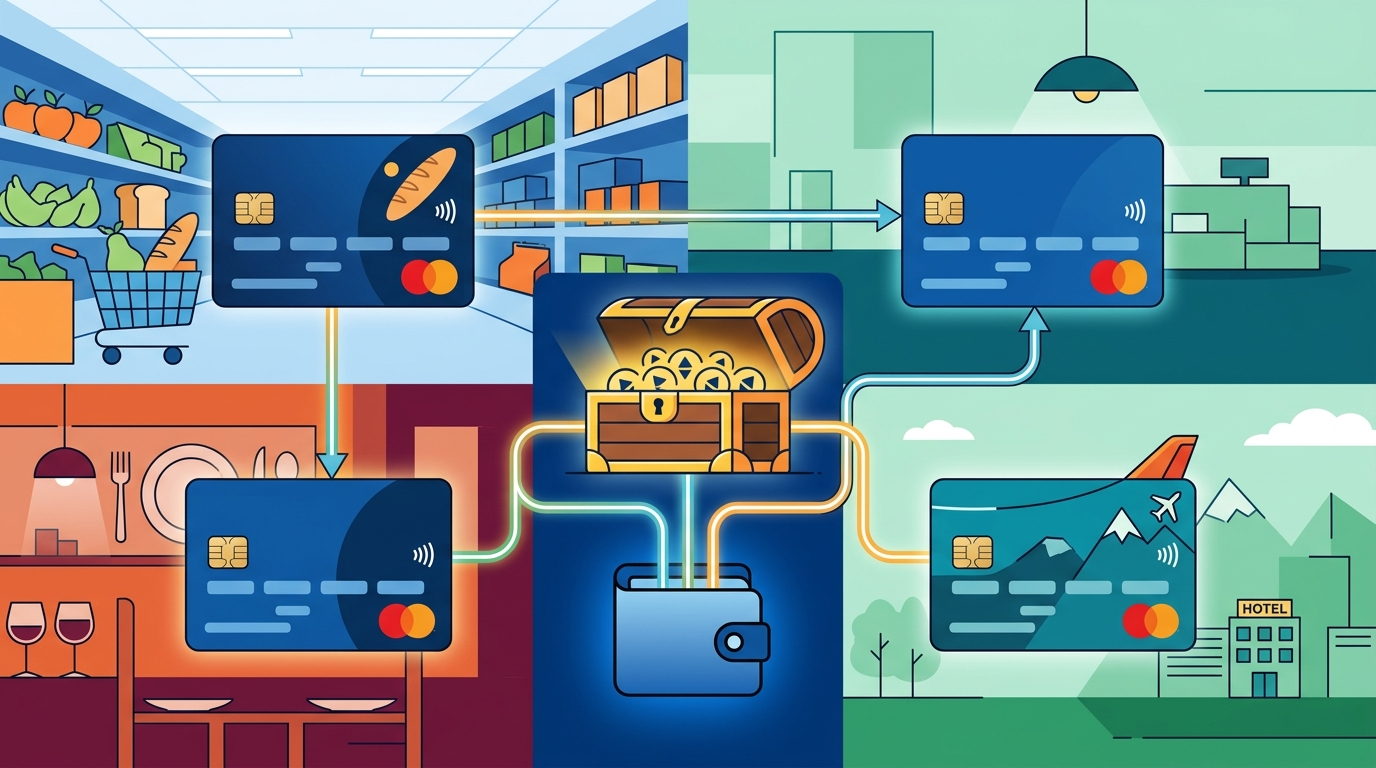
A card combination is a deliberate pairing in which each card covers different bonus categories while earning the same transferable currency (or complementary cash-back programs). Three principles guide every strong combo:
1. Minimal Category Overlap
Choose cards whose highest-earning categories do not duplicate each other. If both cards earn 3x on dining, one of those slots is wasted.
2. A Strong Flat-Rate Backstop
A flat-rate rewards card is a card that earns the same percentage on every purchase regardless of category. The current industry standard sits at 1.5% to 2% back. This card handles all spending that falls outside your bonus categories.
3. Net-Positive Annual Fees
Premium cards carry higher fees but include statement credits and perks that offset the cost. Before adding a card, verify that the rewards and credits you will actually use exceed the annual fee.
The Chase Trifecta
The Chase Trifecta is a three-card strategy that maximizes Ultimate Rewards points by assigning each card to different purchase types. All three cards pool points into one account, which can then be transferred to 13 airline and hotel partners.
| Card | Best For | Top Earn Rate | Annual Fee |
|---|---|---|---|
| Chase Sapphire Preferred | Dining, streaming, online groceries | 3x-5x | $95 |
| Chase Freedom Flex | Rotating quarterly categories | 5x (up to $1,500/qtr) | $0 |
| Chase Freedom Unlimited | Flat-rate catch-all | 1.5x everything | $0 |
This setup ensures you earn at least 1.5x on every dollar and 3x-5x on dining, drugstores, travel, and quarterly bonus categories. For frequent travelers, swapping the Sapphire Preferred for the Sapphire Reserve upgrades lounge access and raises the travel portal redemption rate to 1.5 cents per point.
The Amex Trifecta
American Express builds its trifecta around Membership Rewards, a currency transferable to 20 airline and hotel partners. The classic lineup:
| Card | Best For | Top Earn Rate | Annual Fee |
|---|---|---|---|
| Amex Platinum | Flights booked direct or via Amex Travel | 5x | $695 |
| Amex Gold | U.S. restaurants, U.S. supermarkets | 4x | $325 |
| Amex Blue Business Plus | Flat-rate catch-all | 2x (up to $50K/yr) | $0 |
The Platinum and Gold cards have minimal overlap in both bonus categories and statement credits, which means holding both delivers outsized combined value. With the Blue Business Plus as a 2x backstop, every non-bonused purchase still earns double.
Best Cash-Back-Only Combo
Not everyone wants to manage transfer partners. A pure cash-back combo keeps things simple while still beating a single-card strategy. A strong two-card pairing: pair the Chase Freedom Flex (5% rotating categories, 3% dining and drugstores) with the Wells Fargo Active Cash Card (flat 2% on everything else). This no-annual-fee duo covers most spending at 2% or higher.
Alternatively, match the Discover it Cash Back (5% rotating categories) with the Citi Double Cash (2% on all purchases). Either way, the rotating-category card handles spikes in seasonal spending while the flat-rate card sweeps up everything else.
Cross-Issuer Power Pairing
Mixing issuers diversifies your points portfolio and unlocks multiple transfer-partner networks. A popular cross-issuer duo pairs the Chase Sapphire Preferred with the Capital One Venture, giving you access to both Chase's 13 partners and Capital One's 15+ partners through a single wallet.
The trade-off is that you cannot pool points across issuers the way you can within a single ecosystem. This is where an automated optimizer becomes essential: it tracks which card earns the best net return at each merchant, factoring in earn rates, transfer ratios, and your personal redemption goals.
How to Automate Your Card Strategy
Building the right combo is step one. Knowing which card to pull out at every register is step two, and it is where most people leak value. Savvx connects to your bank accounts read-only through Plaid, then analyzes your real spending against a catalog of 343 cards and 130+ transfer partners. The platform models point values based on how you actually travel, not inflated headline rates.
Because Savvx is funded entirely by subscription fees with zero affiliate links, card-issuer kickbacks, or data sales, its recommendations optimize purely for your rewards math. The system also alerts you to annual-fee credits you have not yet used, sign-up bonus thresholds you are close to hitting, and program devaluations that affect cards you hold.
Key Takeaways
- A two- to three-card combination covers the vast majority of spending categories at 2x or higher.
- The Chase Trifecta and Amex Trifecta are the two most popular same-issuer ecosystems for transferable points.
- A flat-rate card earning at least 1.5% to 2% is the foundation of every strong combo.
- Cross-issuer pairings diversify transfer partners but require more active management.
- Annual fees only make sense when credits and rewards you actually use exceed the cost.
- Automating card selection with a tool like Savvx removes guesswork and prevents leaked value.
- Always pay your statement balance in full; interest charges instantly negate any rewards earned.
Frequently Asked Questions
How many credit cards should I combine for rewards?
Most people hit optimal rewards with two to three cards. Beyond four or five, the added complexity usually outweighs the incremental benefit. Start with one bonus-category card and one flat-rate card, then add a third if a clear gap remains.
What is the Chase Trifecta?
The Chase Trifecta is a three-card strategy using the Sapphire Preferred (or Reserve), Freedom Flex, and Freedom Unlimited. All three earn Chase Ultimate Rewards points that can be pooled and transferred to 13 airline and hotel partners.
Can I combine points from different card issuers?
Generally, no. Points earned with Chase cards cannot be merged with Amex Membership Rewards or Capital One miles. You can, however, transfer each issuer's points independently to overlapping airline or hotel partners.
Do I need a premium card with an annual fee?
Not necessarily. A no-annual-fee pair like the Chase Freedom Flex and Wells Fargo Active Cash still earns 2% or more on most spending. Premium cards make sense when you will use enough of their travel credits and perks to offset the fee.
How does Savvx help me choose the right card combination?
Savvx reads your transaction history (read-only via Plaid), models every card's net value against your actual spending, and tells you exactly which card to use at every merchant. Because it earns revenue only from your subscription, its advice is completely unbiased.
What is a flat-rate rewards card?
A flat-rate rewards card is a credit card that earns the same cash-back or points percentage on every purchase, regardless of merchant category. Common examples include the Citi Double Cash at 2% and the Chase Freedom Unlimited at 1.5%.
Should I close a card that no longer fits my combo?
Before closing, consider downgrading to a no-fee version to preserve your credit history and available credit. Tools like Savvx can model whether keeping, downgrading, or closing a card produces the best net outcome for your profile.
How often should I re-evaluate my card portfolio?
At least once a year, or whenever your spending patterns shift significantly (new job, relocation, lifestyle change). Programs also devalue periodically, so staying current matters.
Start Maximizing Your Rewards Today
Stop guessing which card to swipe. Try Savvx and let data-driven optimization squeeze every point out of every purchase, backed by a subscription model that guarantees unbiased advice.