

How to Automate Your Financial Analysis and Planning in 2026
Managing personal finances used to mean spreadsheets, manual receipt tracking, and hours of guesswork. Not anymore. In 2026, AI-powered tools can analyze your spending, optimize your credit-card rewards, forecast cash flow, and flag missed opportunities, all without you lifting a finger. The short answer to "Can I automate my financial analysis and planning?" is a resounding yes. This guide walks you through the landscape of automation tools, what actually works, and how to set up a system that runs on autopilot while maximizing every dollar you earn and spend.
What Financial Automation Really Means
Financial automation is the use of technology to replace manual tasks like data entry, categorization, and report generation so you can focus on decisions instead of data wrangling. At the enterprise level, tools like Workday Adaptive Planning and Anaplan handle budgets across departments. At the personal level, the same principles apply: connect your accounts, let software categorize transactions, and receive actionable insights automatically.
Automation in Financial Planning and Analysis (FP&A) uses technology to replace manual tasks like data entry and report generation, enabling teams to focus on strategic analysis and planning. The same logic applies to your household finances. When your tools do the heavy lifting, you make better choices with less effort.
Why Manual Tracking Is Costing You Money
According to research cited by Drivetrain, FP&A teams spend 85% of their time gathering and preparing data and only 15% generating insights. The ratio for individuals managing multiple credit cards is arguably worse. You miss sign-up bonus deadlines, forget to use annual-fee credits, and swipe the wrong card at the grocery store, all because the data is scattered.
The opportunity cost is real. Even saving two hours per week on financial housekeeping compounds into over 100 hours a year you could spend on decisions that actually grow your wealth. Automated tools eliminate the busywork and surface only what matters.
Types of Financial Automation Tools
Budgeting and Cash-Flow Apps
Traditional budgeting apps connect to your bank and categorize spending. They are useful for tracking where money goes but rarely tell you how to optimize it. They answer "what happened" but not "what should I do next."
AI-Powered FP&A Platforms
Enterprise FP&A platforms like Cube, Planful, and Vena use predictive forecasting, anomaly detection, and scenario modeling to guide corporate decisions. These features are now trickling down to consumer-grade tools.
Credit-Card Optimization Services
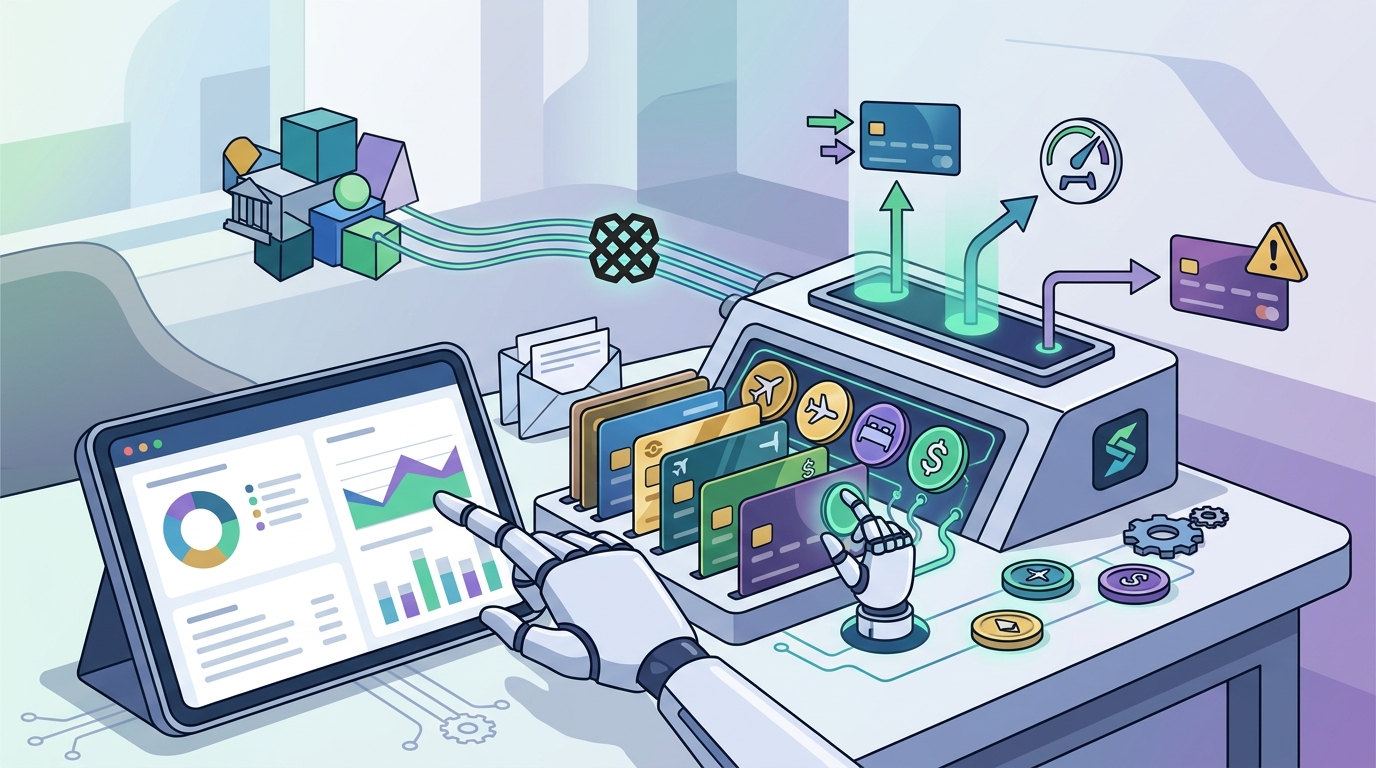
A credit-card optimization service is a tool that analyzes your real spending patterns against a catalog of cards and tells you exactly which card to use for every purchase. Savvx is a subscription-based example: it reviews your transactions, models the true value of points based on how you actually travel, and surfaces actions like which card to swipe at which merchant or which annual-fee credits you are leaving unused.
How Secure Bank Connections Power Automation
Nearly every modern finance automation tool relies on Plaid to connect to your bank. Plaid is a fintech service that acts as a secure intermediary between your bank accounts and third-party apps. It uses AES-256 encryption, Transport Layer Security (TLS), and multi-factor authentication to protect data end-to-end.
Critically, Plaid provides read-only access. It cannot move money or modify your accounts. Over 8,000 apps and 12,000 banking institutions worldwide use Plaid, including household names like Venmo, Robinhood, and SoFi. Savvx uses Plaid's read-only connection so your data flows securely without any risk of unauthorized transactions.
Automating Credit-Card Reward Optimization
Most people carry three to five credit cards but use only one or two regularly, leaving hundreds or thousands of dollars in rewards on the table each year. An automated optimizer solves this by matching every spending category to the card in your wallet that earns the highest return.
Savvx goes further than simple category matching. It analyzes your real spending against a curated catalog of 343 cards and 130+ transfer partners, models point values based on your personal travel habits (not inflated portal rates), and alerts you to issuer devaluations, expiring credits, and cards worth downgrading. Because its only revenue is the user's subscription fee, with no affiliate links or card-issuer kickbacks, the recommendations optimize purely for your rewards math.
Comparing Personal Finance Automation Approaches
| Feature | Budgeting Apps | Affiliate-Based Card Sites | Subscription Optimizers (e.g., Savvx) |
|---|---|---|---|
| Spending categorization | Yes | Limited | Yes |
| Card-swipe recommendations | No | Sometimes | Yes, per merchant |
| True point-value modeling | No | No (headline rates) | Yes (personalized travel value) |
| Sign-up bonus tracking | No | Yes (affiliate-driven) | Yes (unbiased) |
| Annual-fee credit alerts | No | Rare | Yes |
| Revenue model | Ads / freemium | Affiliate commissions | Subscription only |
| Conflict of interest | Moderate | High | None |
The table above illustrates a fundamental difference: when a service earns commissions from card issuers, its incentives may not align with yours. A subscription model removes that conflict entirely.
Getting Started: A Step-by-Step Setup
Step 1: Audit Your Current Cards
List every credit card you hold, its annual fee, and the rewards categories it covers. This gives you a baseline to measure improvement.
Step 2: Connect Your Accounts Securely
Choose a tool that uses Plaid or a similar read-only aggregator. On Savvx, this takes under two minutes. Your bank credentials are never stored by the app itself; Plaid handles authentication with bank-grade encryption.
Step 3: Review Automated Recommendations
Once your spending data is imported, the tool analyzes transactions and generates a prioritized action list: which card to use where, which bonus you are closest to earning, and which credits to redeem before they expire. Follow the highest-impact actions first.
Key Takeaways
- Yes, you can fully automate personal financial analysis in 2026 using AI-powered tools and secure bank connections.
- Plaid provides read-only, encrypted access to your accounts across 12,000+ institutions.
- Automated credit-card optimization can recover hundreds of dollars per year in missed rewards.
- Subscription-only models like Savvx eliminate affiliate conflicts so recommendations serve you, not card issuers.
- Savvx analyzes 343 cards and 130+ transfer partners against your real spending to find the optimal card for every purchase.
- Enterprise automation principles (anomaly detection, scenario modeling) are now available at the consumer level.
- Getting started takes minutes: connect accounts, review recommendations, and act on the highest-value items first.
Frequently Asked Questions
Can I really automate all of my financial planning?
You can automate the analytical and data-gathering portions, which represent the vast majority of the work. Strategic decisions like setting savings goals still require your input, but the tools surface the data you need to decide quickly.
Is it safe to connect my bank account through Plaid?
Plaid uses AES-256 encryption, TLS, and multi-factor authentication. It provides read-only access, meaning it cannot move money or alter your accounts. Plaid is certified under ISO 27001 and ISO 27701 data-security standards.
How does Savvx differ from free card-recommendation sites?
Free sites typically earn affiliate commissions from card issuers, which can bias recommendations toward cards that pay the site more. Savvx charges a subscription fee as its only revenue, so its recommendations are optimized entirely for your rewards math.
How many credit cards does Savvx analyze?
Savvx maintains a curated catalog of 343 cards and over 130 transfer partners, and it models real point values based on your personal travel habits rather than generic portal rates.
Will automation replace my financial advisor?
Automation handles day-to-day optimization like card selection, bonus tracking, and fee-credit reminders. For complex estate planning, tax strategy, or investment management, a human advisor still adds significant value. The two complement each other.
What kind of savings can I expect?
Results vary by spending volume and card portfolio, but users who switch from a single everyday card to an optimized multi-card strategy often recover $500 to $2,000 or more per year in additional rewards and avoided fees.
Do I need technical knowledge to set this up?
No. Modern tools like Savvx are designed for non-technical users. You connect your bank through Plaid's familiar interface, and the platform handles categorization, analysis, and recommendations automatically.
How often should I review my automated recommendations?
A monthly check is sufficient for most people. The tool sends alerts for time-sensitive actions like expiring credits or program devaluations, so you will not miss critical deadlines even between reviews.
Start Automating Your Rewards Today
Stop leaving money on the table. Explore Savvx pricing and connect your accounts in under two minutes to see exactly how much more you could be earning from the cards already in your wallet.