

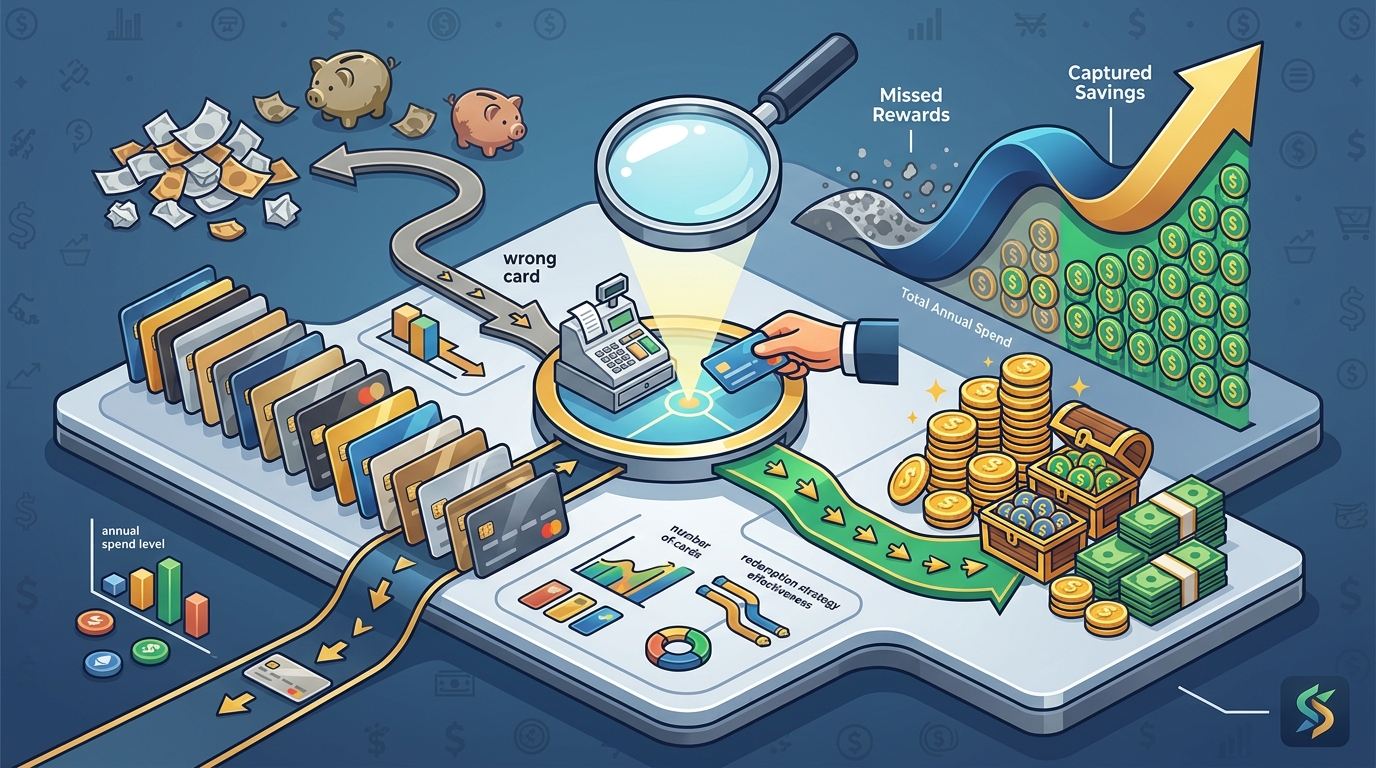
Americans charged $3.6 trillion to credit cards in 2024, yet most cardholders leave hundreds or even thousands of dollars in rewards on the table every year by swiping the wrong card at the wrong merchant. Credit card optimization is the practice of matching each purchase to the card in your wallet that earns the highest effective reward for that spending category. The savings potential depends on your annual spend, the number of cards you hold, and how strategically you redeem your points. Below, we break down exactly how much you stand to gain and the fastest ways to capture that value.
The Rewards Gap: What Most People Miss
Credit card rewards optimization is the process of using each card in your wallet for the specific purchase category where it earns the most points, miles, or cash back. Most people default to a single card for everything. That habit costs real money.
According to the CFPB's 2025 report, 92% of general-purpose card spending was on reward cards in 2023 and 2024. The infrastructure for earning is already there; the gap is in how those rewards are captured and redeemed. Industry estimates suggest that using the wrong card on the wrong purchase can cost a household between $1,200 and $2,000 per year in forfeited rewards.
The Math Behind Card Optimization
Consider a household spending $60,000 annually across credit cards. A flat 2% cash-back card returns $1,200 per year. But if you route grocery spending (averaging $6,000/year) to a card earning 4%, dining ($4,800/year) to a card earning 4x points, and travel ($3,600/year) to a card earning 5x, the numbers shift dramatically.
| Category | Annual Spend | Flat 2% Return | Optimized Return | Incremental Gain |
|---|---|---|---|---|
| Groceries | $6,000 | $120 | $240 (4%) | +$120 |
| Dining | $4,800 | $96 | $192 (4%) | +$96 |
| Travel | $3,600 | $72 | $180 (5%) | +$108 |
| Gas/Transit | $3,000 | $60 | $150 (5%) | +$90 |
| All Other | $42,600 | $852 | $852 (2%) | $0 |
| Total | $60,000 | $1,200 | $1,614 | +$414 |
That $414 uplift comes from category optimization alone, before factoring in sign-up bonuses, transfer-partner leverage, or annual-fee credits. When you layer those in, total incremental value can exceed $1,500 per year for an active cardholder.
Where the Biggest Savings Hide
Bonus Categories You Already Spend In
Cards like the Amex Gold or Chase Sapphire Preferred earn 3x to 4x on dining and groceries. If your spend is concentrated in those areas and you are using a flat-rate card instead, you are leaving the largest share of incremental rewards unclaimed. A tool like savvX analyzes your real transactions to surface exactly which card beats which for every merchant you visit.
Transfer-Partner Multipliers
A transfer partner is a loyalty program (airline or hotel) to which you can move credit card points, often at a 1:1 ratio, for redemptions worth significantly more than the portal rate. savvX tracks 130+ transfer partners and models the true value of points based on how you actually travel, not inflated headline valuations.
Forgotten Credits
Premium cards bundle statement credits for streaming, dining, rideshare, and airline incidentals. The CFPB found that annual fee revenue nearly tripled from $3 billion in 2015 to $8.7 billion in 2024. Issuers justify those fees with credits, but only if you actually use them. Automated tracking ensures you never leave a credit unclaimed.
Annual Fees: When They Pay for Themselves
An annual fee is the yearly charge a card issuer collects in exchange for premium perks and higher earning rates. According to CNBC Select, the average annual fee more than doubled from $62 in 2015 to $127 in 2024. Premium cards have climbed even higher: the Amex Platinum rose to $895, and the Chase Sapphire Reserve to $795 in 2025.
Does the math still work? It depends on your spending profile. A card with $400 in usable credits and 3x earning on $20,000 of annual dining spend can deliver over $1,000 in net value after the fee. But if you are not redeeming those credits, it is a net loss. savvX calculates the real net value of every card you hold and tells you when to keep, downgrade, or close based on your actual usage.
Welcome Bonuses: The Fastest Dollar-for-Dollar Win
A welcome bonus is a lump-sum reward, usually worth $200 to $1,000 or more, earned after meeting a minimum spending requirement within a set timeframe. These bonuses represent the single largest per-card payout most consumers will ever receive.
Missing a single welcome bonus deadline can cost more than years of optimized category spending. For instance, failing to hit a $4,000 spend requirement for a 60,000-point bonus (worth roughly $750 in travel) is a significant loss. savvX tracks your progress toward each bonus threshold and alerts you before deadlines pass.
Why Automation Beats Spreadsheets
Manual optimization requires tracking rotating categories, monitoring annual-fee renewal dates, checking transfer-partner promotions, and mapping every merchant to the right card. It works for hobbyists, but most people lack the time. savvX connects to your accounts through Plaid (read-only) and analyzes real spending against a catalog of 343 cards to recommend which card to use at every merchant.
Critically, savvX earns revenue only from your subscription fee. There are no affiliate links, no card-issuer kickbacks, and no data sales. That business model means the recommendations optimize for your rewards math, not a referral payout. You can review the privacy policy and terms of service to confirm this commitment.
Key Takeaways
- Switching from a single flat-rate card to an optimized multi-card strategy can add $400 to $1,500+ per year in incremental rewards.
- Welcome bonuses are the fastest way to earn, with payouts of $200 to $1,000+ per card.
- Annual fees pay for themselves only when you actively use the bundled credits and earn enough in bonus categories to offset the cost.
- Transfer partners can multiply the value of your points by 1.5x to 3x compared to cash-back redemption.
- Automation eliminates the spreadsheet burden and catches expiring credits, bonus deadlines, and program devaluations in real time.
- Unbiased tools like savvX, which earn zero from card issuers, guarantee that recommendations serve your wallet, not a referral fee.
- Americans charged $3.6 trillion on credit cards in 2024; even a 0.5% improvement in effective earn rate yields billions in aggregate consumer value.
Frequently Asked Questions
How much can the average person save by optimizing credit cards?
On a $60,000 annual spend, moving from a flat 2% card to an optimized strategy across bonus categories, welcome bonuses, and transfer partners can yield $400 to $1,500+ in additional value each year.
Is it worth paying an annual fee for a rewards card?
It depends on whether you use the card's credits and earn enough in bonus categories to exceed the fee. Premium cards with $400+ in usable credits can deliver positive net value even at annual fees above $500.
What is credit card optimization?
Credit card optimization is the practice of routing each purchase to the card in your wallet that earns the highest effective reward rate for that merchant or spending category.
How does savvX help maximize credit card rewards?
savvX connects to your bank accounts via Plaid (read-only), analyzes your actual spending against 343 cards and 130+ transfer partners, and tells you which card to use at every merchant. Its only revenue is your subscription fee, ensuring unbiased recommendations.
Do I need multiple credit cards to benefit from optimization?
Even two cards can make a meaningful difference. For example, pairing a category-bonus card for dining and groceries with a flat-rate card for everything else immediately raises your effective earn rate.
What are transfer partners and why do they matter?
Transfer partners are airline and hotel loyalty programs that accept credit card points, often at a 1:1 ratio. Redeeming through partners can stretch points to 1.5 to 3 cents per point, compared to 1 cent through a basic cash-back redemption.
How do I know when to close or downgrade a card?
Compare the card's annual fee against the total value you receive from its credits, rewards, and perks. If the net value is negative, downgrading to a no-fee version preserves your credit history while eliminating the cost. savvX surfaces this calculation automatically.
Is my data safe when I connect my bank accounts?
savvX uses Plaid for read-only access to transaction data. It does not store login credentials, and the business model (subscription-only, no data sales) means there is no financial incentive to monetize your information.
Start Seeing What You Are Missing
Every swipe on the wrong card is money you will never get back. Try savvX today to see exactly how much you are leaving on the table and which card to use for every purchase going forward.