

How to Maximize Credit Card Rewards Based on Your Actual Spending
Americans earned a staggering $47 billion in credit card rewards in 2024, yet billions went unredeemed. The gap between what you could earn and what you actually pocket comes down to one thing: whether you are using the right card for every purchase. Credit card optimization is the practice of matching each transaction to the card in your wallet that returns the highest reward value. This guide walks you through a practical, data-driven process for squeezing maximum value from every swipe, tap, and click, without relying on advice that is secretly paid for by card issuers.
Why Most Cardholders Leave Money on the Table
A 2025 Bankrate survey found that 25% of Americans did not redeem any credit card rewards in the prior year. According to the CFPB, 2.8% of all rewards were forfeited at the end of 2024, and the rate climbed to 7.1% for subprime cardholders.
The root causes are complexity and misalignment. Many people carry two or three cards but use only one for everything. Others earn travel points they never transfer, or miss annual-fee credits that expire quarterly. A rewards credit card is only valuable if your spending patterns actually trigger its bonus categories.
Step 1: Know Your Real Spending Breakdown
Self-reported spending is notoriously inaccurate. People overestimate dining and underestimate subscriptions. The first step in any optimization strategy is connecting your actual transaction data so you can see exactly where your money goes each month.
Why Real Data Beats Guesswork
Tools like Savvx connect to your bank accounts through Plaid on a read-only basis, automatically categorizing every transaction. This eliminates the guesswork that causes most people to choose the wrong card at checkout.
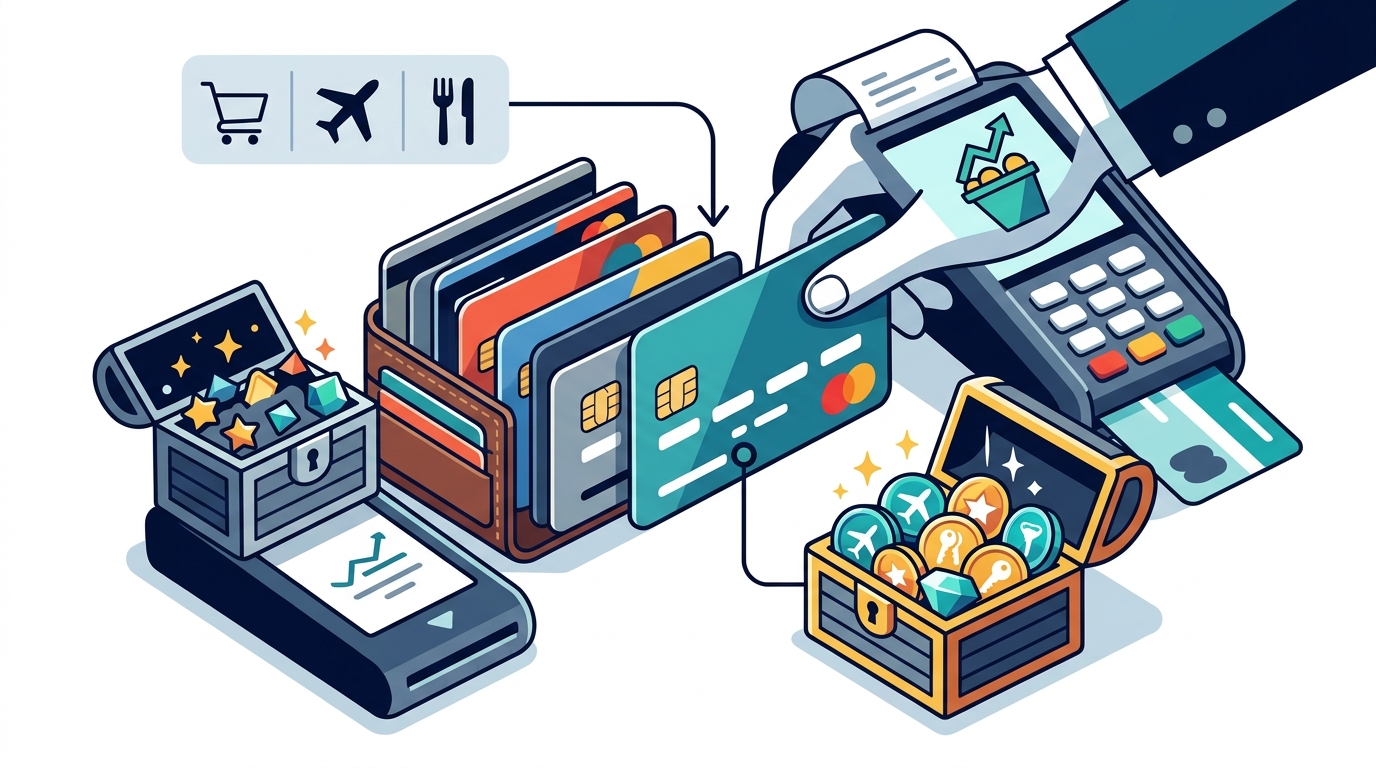
Common Spending Categories to Track
| Category | Typical Household Annual Spend | Top Reward Rate Available |
|---|---|---|
| Groceries | $6,000 - $8,000 | Up to 6% cash back |
| Dining | $3,000 - $5,000 | Up to 4x points |
| Gas / Transit | $2,000 - $3,500 | Up to 5% cash back |
| Travel (flights, hotels) | $2,000 - $6,000 | Up to 5x points |
| Online Shopping | $2,000 - $4,000 | Up to 5% cash back |
| Everything Else | Varies | 2% flat-rate cash back |
Step 2: Match Each Category to the Best Card
Card matching is the process of assigning your highest-reward card to each spending category. For example, if you spend $500 a month at supermarkets, a card offering 6% back on groceries returns $360 per year in that category alone, versus $120 from a flat 2% card. That is a $240 difference from a single category.
The Multi-Card Strategy
Most optimized wallets contain three to five cards: one for groceries, one for dining and travel, one for rotating bonus categories, and a strong flat-rate card as a catch-all. Savvx analyzes your real spending against a catalog of 343 cards and 130+ transfer partners to recommend the ideal combination for your habits.
Step 3: Target Sign-Up Bonuses Strategically
A sign-up bonus is a one-time reward (often 50,000 to 100,000 points) that a card issuer grants after you meet a minimum spending threshold within a set period, typically three months. These bonuses can be worth $500 to $1,500 when redeemed wisely.
The key is timing. Open a new card when you have planned large expenses, like a vacation or appliance purchase, that naturally meet the spend threshold. Avoid manufactured spending or overspending just to chase a bonus. As LendingTree analyst Matt Schulz told Fortune, carrying even one month of interest at today's 21%+ APRs can wipe out the bonus entirely.
Step 4: Redeem for Maximum Value, Not Convenience
Point valuation is the estimated real-world dollar value of a single rewards point when redeemed through a specific channel. Not all redemptions are equal. Statement credits often yield just 0.5 to 1 cent per point, while transferring to airline partners can yield 1.5 to 2.5 cents per point or more.
Transfer Partners Are the Key
Programs like Chase Ultimate Rewards, Amex Membership Rewards, and Capital One Miles let you transfer points to airline and hotel loyalty programs. Savvx models the true value of points based on how you actually travel, not headline portal rates, and surfaces the best transfer opportunities automatically.
Step 5: Run the Annual-Fee Math Every Year
A premium card with a $550 annual fee can still be a net positive if its credits (airline incidentals, dining, streaming, lounge access) exceed the fee based on your usage. But spending habits change. A card that was worth keeping last year might not be this year.
Savvx tracks which annual-fee credits you have used and which are expiring, then recommends whether to keep, downgrade, or cancel each card based on its real net value to you. This is the kind of ongoing maintenance most people skip.
Step 6: Automate the Whole Process
Manual spreadsheets break down as your card count grows and issuers change bonus categories quarterly. Automation solves this. The Savvx Smart Wallet browser extension shows a real-time recommendation banner on merchant websites you visit, telling you which card to pull out before you check out.
Importantly, the recommendations you receive should be unbiased. Many popular card-recommendation sites earn affiliate commissions when you apply through their links. Savvx operates on a subscription-only model with no affiliate links, no card-issuer kickbacks, and no data sales, so every recommendation optimizes for your rewards math, not someone else's payout.
Key Takeaways
- Americans earned $47 billion in credit card rewards in 2024 but left billions unredeemed. Using the right card for every purchase closes that gap.
- Real transaction data, not self-reported estimates, is the foundation of accurate card optimization.
- A multi-card strategy with three to five cards typically outperforms any single card.
- Sign-up bonuses are powerful but only if you meet the spend threshold without carrying a balance.
- Point transfers to airline and hotel partners frequently yield 50% to 150% more value than statement credits.
- Annual-fee cards should be re-evaluated yearly; credits you do not use are money wasted.
- Unbiased tools funded by subscription fees, not affiliate commissions, ensure recommendations truly serve you.
Frequently Asked Questions
How much are Americans leaving in unclaimed credit card rewards?
According to a WalletHub study, Americans left $27.9 billion in credit card rewards unclaimed in 2024. The average household lost an estimated $583 in rewards that were earned but never redeemed.
What is credit card optimization?
Credit card optimization is the practice of analyzing your spending patterns and assigning the highest-reward card to each purchase category so you earn the maximum possible return on every transaction.
Do I need a lot of credit cards to maximize rewards?
Not necessarily. Most optimized wallets use three to five cards. The goal is covering your top spending categories with a strong bonus card and using a flat-rate card for everything else.
How do I know which card to use at a specific store?
Tools like Savvx analyze your cards and spending to recommend the best card for each merchant. The Savvx Smart Wallet extension even shows a recommendation banner during online checkout.
Are credit card recommendation sites biased?
Many popular sites earn affiliate commissions from card issuers, which can influence which cards they promote. Savvx avoids this conflict by charging a subscription fee as its only revenue source, with zero affiliate links or issuer payments.
Is it worth paying an annual fee for a rewards card?
It depends on your spending. A $550-fee card can deliver $800 or more in net value through credits, lounge access, and elevated earning rates, but only if you actually use those perks. Run the math annually.
How do I get the most value from my credit card points?
Transfer points to airline and hotel loyalty partners instead of redeeming for statement credits. Transfers often yield 1.5 to 2.5 cents per point compared to 0.5 to 1 cent for cash-back redemptions.
Is it safe to connect my bank account to an optimization tool?
Savvx connects through Plaid, which provides read-only access to your transaction data. It cannot move money or see your full account numbers. You can review the Savvx privacy policy for full details.
Start Optimizing Your Wallet Today
Every swipe on the wrong card is money quietly lost. Try Savvx to see exactly how much you are leaving on the table and get unbiased, data-driven card recommendations built entirely around your real spending.