

How to Maximize Credit Card Rewards Based on Your Actual Spending
Americans earned a staggering $47 billion in credit card rewards in 2024, yet nearly 70% of rewards cardholders are sitting on unused cash back, points, or miles. The gap between what people could earn and what they actually pocket is enormous. The fix is not about getting more cards. It is about using the right card for every purchase based on your real spending patterns. This guide walks you through a proven, data-driven process for squeezing maximum value from the cards already in your wallet.
Why Most People Leave Money on the Table
Credit card reward optimization is the practice of selecting the highest-earning card in your wallet for each spending category. Most people never do it. According to the CFPB, cardholders earned an average of just 1.6 cents in rewards per dollar spent in 2024. Strategic users routinely earn 2.5% to 5% or more.
A LendingTree survey found that nearly 70% of rewards cardholders have unredeemed cash back, points, or miles. Why? Confusion, complexity, and inertia. About 11% of non-redeemers say they simply do not know how to redeem, and 9% find the programs too confusing.
Step 1: Audit Your Actual Spending
Self-reported estimates are unreliable. Most people overestimate dining and underestimate subscriptions and utilities. A spending audit is a detailed review of your actual transactions, categorized by merchant type, over the past 3 to 12 months.
Use Read-Only Bank Connections
Services like savvX connect to your accounts through Plaid in read-only mode. This means your real transaction data drives the analysis, not guesswork. savvX analyzes your spending against a catalog of 343 cards and 130+ transfer partners to tell you exactly which card to use where.
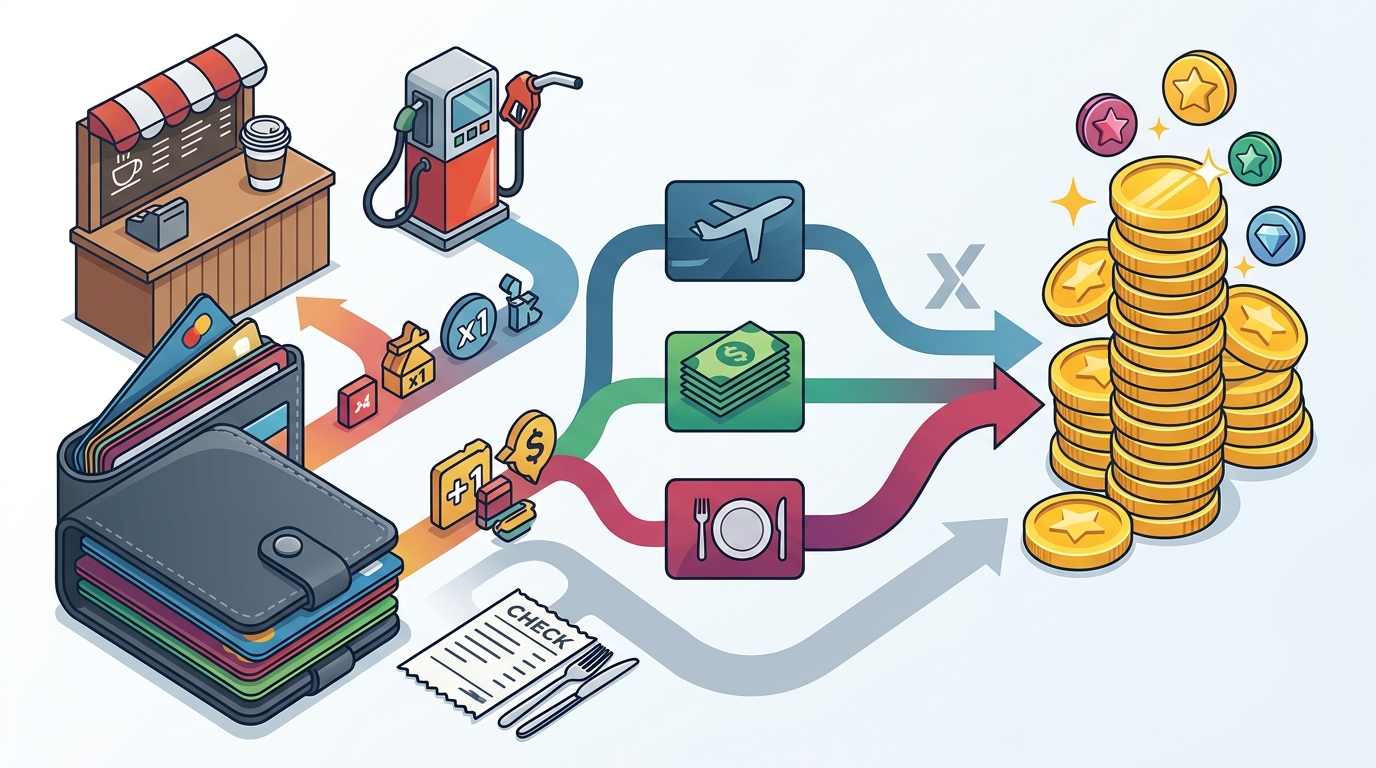
Categorize Every Dollar
Break spending into at least six buckets: groceries, dining, travel, gas, online shopping, and everything else. The goal is to identify where your highest-volume categories intersect with the best bonus multipliers in your wallet.
Step 2: Match Cards to Categories
Once you know where your money goes, map the optimal card to each category. Here is an example of how category matching works for a typical two-card wallet:
| Spending Category | Annual Spend | Flat 2% Card Return | Optimized Card Return | Difference |
|---|---|---|---|---|
| Groceries | $7,200 | $144 | $432 (6% up to cap) | +$288 |
| Dining | $4,800 | $96 | $192 (4x points) | +$96 |
| Travel | $3,600 | $72 | $180 (5x portal) | +$108 |
| Gas | $2,400 | $48 | $72 (3%) | +$24 |
| Everything Else | $18,000 | $360 | $360 (2%) | $0 |
| Total | $36,000 | $720 | $1,236 | +$516 |
That is an extra $516 per year from the same spending, no extra purchases required. The key is never defaulting to one card for everything.
Step 3: Track Sign-Up Bonuses and Credits
A sign-up bonus is a one-time reward issued by a card company after you meet a minimum spending threshold within a set period, typically 3 months. The average credit card sign-up bonus was worth $311 in 2024 according to the CFPB. Strategic cardholders time new applications around large planned purchases to hit these thresholds organically.
Do Not Forget Annual-Fee Credits
Premium cards often bundle statement credits for dining, travel, streaming, or airline incidentals. These credits offset the annual fee but only if you actually use them. savvX's approach surfaces exactly which credits you are leaving on the table and when they reset, so you never miss a deadline.
Step 4: Value Your Points Correctly
Points valuation is the process of determining what a loyalty point is actually worth based on your personal redemption habits. A Chase Ultimate Rewards point redeemed for cash back is worth 1 cent. Transferred to Hyatt and used for a premium hotel night, it can be worth 2 cents or more. The headline "value" published on comparison sites often assumes redemptions most people never make.
savvX models the true value of your points based on how you actually travel, not inflated portal rates. This is critical because overvaluing points can lead you to keep a card whose annual fee exceeds its real benefit to you. You can explore savvX's subscription-only model to see how unbiased analysis works when there are zero affiliate kickbacks influencing the math.
Step 5: Automate With a Card Optimizer
Manually tracking rotating categories, bonus activations, and spending caps across multiple cards is tedious. A card optimizer is a tool that continuously analyzes your spending and tells you which card to swipe at each merchant in real time.
Why Unbiased Recommendations Matter
Most free recommendation sites earn affiliate commissions when you apply for cards through their links. That creates an incentive to recommend cards that pay them the most, not cards that earn you the most. savvX operates on a different model: subscription revenue is the only revenue. No affiliate links, no card-issuer payments, no data sales. The savvX privacy policy backs this up.
The Chrome Extension Advantage
The savvX Smart Wallet Chrome extension shows a recommendation banner on merchant websites you visit, so you see the optimal card at the moment of purchase. It also auto-syncs your rewards balances across issuers.
Key Takeaways
- Americans left roughly $4 billion in credit card rewards unredeemed in 2024. Optimizing card selection closes that gap.
- Audit your real spending data rather than relying on estimates. Read-only bank connections through Plaid make this secure and accurate.
- Match every spending category to the highest-earning card in your wallet. Even a two-card strategy can yield hundreds more per year.
- Track sign-up bonuses and annual-fee credits actively. The average sign-up bonus alone is worth $311.
- Value points based on how you redeem, not headline rates from comparison sites.
- Automate the process with a card optimizer like savvX that uses your transaction data, not self-reported categories.
- Choose tools funded by your subscription, not by card-issuer affiliate payments, to ensure recommendations serve your wallet.
Frequently Asked Questions
How much can I actually save by optimizing my credit card rewards?
It depends on your spending volume and card lineup, but most multi-card holders can earn $300 to $1,000+ more per year just by using the right card in each category. A Bankrate analyst documented earning a 2.7% overall return on spending in 2024 with only three cards.
Is it safe to connect my bank accounts to a card optimizer?
savvX connects through Plaid in read-only mode. It cannot move money, make charges, or see your passwords. Your data stays in your savvX account and is never sold.
How many credit cards do I need to maximize rewards?
Two to four cards are enough for most people. The average American holds about four credit cards. The goal is covering your top spending categories with bonus-rate cards and having a strong flat-rate card for everything else.
Do free credit card recommendation sites give unbiased advice?
Most free sites earn affiliate commissions from card issuers, which can influence which cards they promote. savvX charges a subscription fee and earns zero from card companies, ensuring recommendations optimize for your rewards math.
What is the difference between points, miles, and cash back?
Cash back is a percentage of your purchase returned as a statement credit or deposit. Points and miles are loyalty currencies issued by banks or airlines whose value varies based on how you redeem them. In 2024, points accounted for $23.9 billion of the $47 billion in total rewards earned.
Should I close a card I am not using?
Not always. Closing a card can reduce your total available credit and shorten your credit history. savvX analyzes the real net value of each card you hold and tells you when to keep, downgrade, or close based on the actual math of annual fees versus rewards earned.
How do I know if my annual fee is worth it?
Add up the rewards you earn from that card plus any statement credits and perks you actually use. Then subtract the annual fee. If the number is negative, consider downgrading. The average annual fee on a consumer credit card was $127 in 2024 according to the CFPB.
Can I maximize rewards without hurting my credit score?
Yes. Pay your balance in full each month, keep utilization below 30%, and avoid opening too many cards in a short window. Rewards optimization is about smarter allocation of existing spending, not increasing your debt.
Start Optimizing Your Rewards Today
Stop guessing which card to pull out at checkout. Connect your accounts to savvX and see exactly how much more you could be earning from the spending you are already doing. No affiliate links. No card-company kickbacks. Just the math that puts more rewards in your pocket.