

Most people carry three to five credit cards but swipe whichever one is on top of the wallet. The result? Hundreds, sometimes thousands, of dollars in missed rewards every year. A credit card transaction analyzer solves this by reading your real spending data and telling you exactly which card to use at every merchant. But not every tool earns your trust equally. Some are funded by the very card issuers whose products they recommend. In this guide, we break down what a trustworthy analyzer looks like, how the technology works, and why the business model behind the tool matters as much as the algorithm.
What Is a Credit Card Transaction Analyzer?
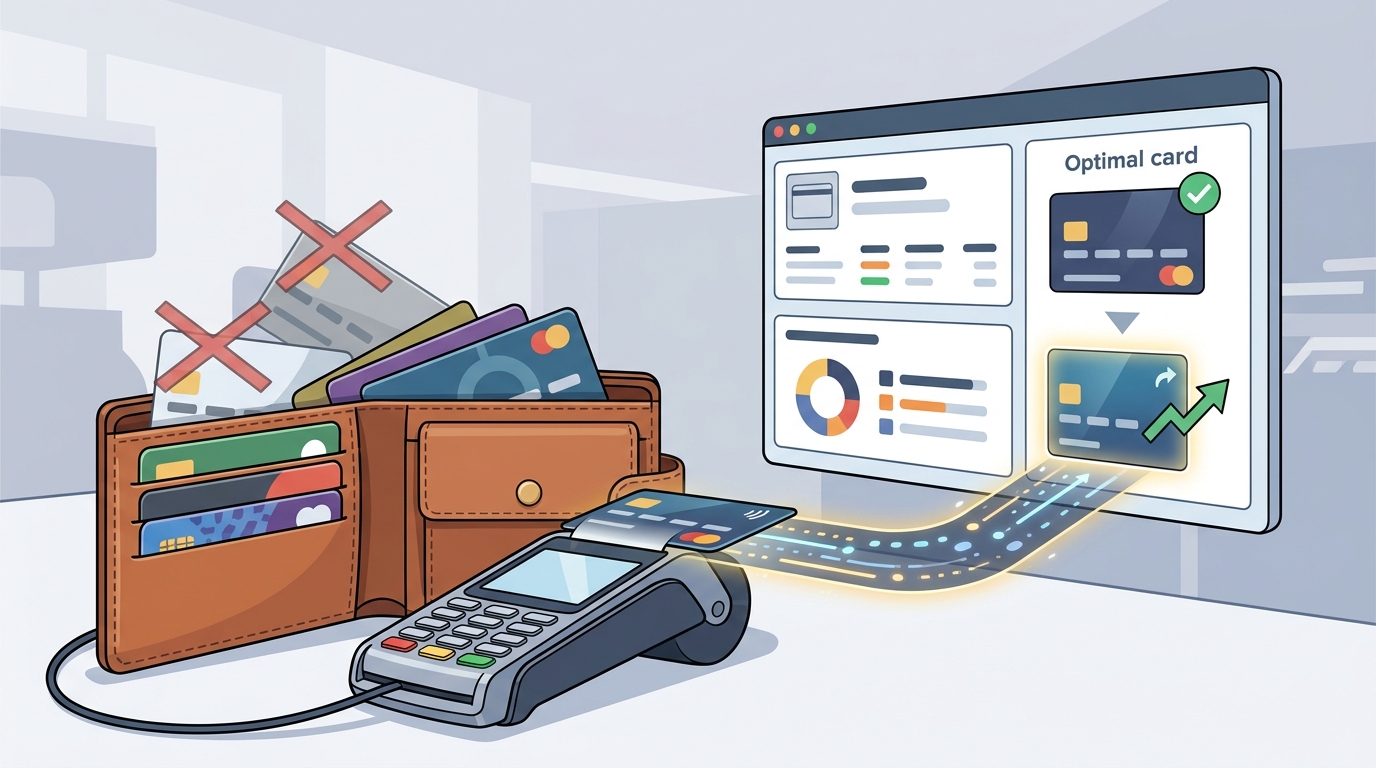
A credit card transaction analyzer is a software tool that ingests your purchase history, categorizes each transaction, and maps it against the rewards structures of available credit cards to surface the optimal card for every spending category. Unlike static comparison sites that rank cards by generic editorial scores, an analyzer personalizes output to your spending patterns.
Think of it as a GPS for your wallet. Instead of guessing whether your grocery run earns more on Card A or Card B, the tool does the math in real time. Savvx, for example, analyzes real transactions against a catalog of 343 cards and over 130 transfer partners to generate per-merchant recommendations.
Why Trust Matters More Than Features
The credit card recommendation space has a well-documented conflict of interest. Most comparison websites earn revenue through affiliate commissions paid by card issuers. As Bankrate openly discloses, placement on their pages can be influenced by advertiser compensation. That does not make their content bad, but it does mean recommendations may favor cards with higher payouts to the publisher.
A trustworthy analyzer removes that incentive entirely. Savvx operates on a subscription-only model: your subscription is the only revenue, with zero affiliate links, no card-issuer kickbacks, no ads, and no data sales. When the only money flowing in comes from users, the math optimizes for the user.
The Affiliate Disclosure Test
Before trusting any recommendation engine, scroll to the footer. If you see language like "we earn a commission from affiliate partners," the tool has a financial relationship with the products it suggests. That is not inherently wrong, but you deserve to know.
How a Transaction Analyzer Works Under the Hood
Step 1: Connect Your Accounts
Modern analyzers use secure, read-only bank connections through services like Plaid. Plaid is a fintech connectivity layer used by over 8,000 apps and 12,000 banking institutions worldwide. Connections are read-only by default, meaning the tool can see transactions but cannot move money or modify your accounts.
Step 2: Categorize and Match
Once transactions flow in, the analyzer classifies each one (groceries, dining, travel, gas, subscriptions) and compares the rewards rate you actually earned against what every other card in its database would have earned.
Step 3: Surface Actionable Recommendations
The output is not a generic "top 10 cards" list. It is a personalized action plan: which card to swipe at which merchant, which sign-up bonus you are closest to hitting, which annual-fee credits you are leaving unused, and when to downgrade or close a card based on its real net value to you. Savvx even models the true value of points based on how you travel, not headline portal redemption rates.
Comparing Analyzer Approaches: Self-Reported vs. Real Data
| Factor | Self-Reported Spending | Real Transaction Data |
|---|---|---|
| Accuracy | Low; users estimate categories | High; actual merchant codes used |
| Setup Effort | Manual entry each time | One-time bank link via Plaid |
| Ongoing Updates | User must re-enter quarterly | Automatic, continuous sync |
| Category Granularity | 5-10 broad buckets | Hundreds of merchant-level codes |
| Missed Spend Detection | None | Flags forgotten subscriptions and credits |
| Revenue Model Risk | Often affiliate-funded | Subscription or affiliate; varies by tool |
Self-reported tools can be a reasonable starting point, but they cannot catch the nuances that move the needle. Real transaction data is the difference between a rough estimate and a precise optimization.
Key Features to Look For
Not all analyzers are created equal. Here are the capabilities that separate a useful tool from a glorified spreadsheet:
- Per-merchant card recommendations based on actual MCC (Merchant Category Code) data.
- Sign-up bonus tracking that tells you how close you are to meeting minimum-spend thresholds.
- Annual-fee credit reminders so you never leave a $300 travel credit or $120 dining credit unused.
- Transfer partner modeling that values points at their real redemption rate across 130+ airline and hotel partners.
- Downgrade and cancellation alerts triggered when a card's net value turns negative after accounting for fees and usage.
- Browser extension support for real-time recommendations at checkout. The Savvx Smart Wallet extension displays a banner on merchant websites showing which card to use while you shop.
Is Connecting Your Bank Account Safe?
Plaid is a secure intermediary that uses AES-256 encryption, multi-factor authentication, and read-only data access to protect financial information. The company holds ISO 27001 and ISO 27701 certifications, and roughly half of U.S. adults have used it to connect a bank account to an app.
When you link through Savvx, the connection is strictly read-only. Savvx cannot move money, and your data stays within your account. You can review the full details on the Savvx privacy policy page, and you can revoke access at any time through Plaid's consumer portal.
Key Takeaways
- A credit card transaction analyzer is a tool that matches your real spending to the best rewards card for each purchase.
- Affiliate-funded recommendation sites have inherent conflicts of interest; always check the revenue model.
- Savvx is the only revenue source is the user's subscription, guaranteeing unbiased, math-driven recommendations.
- Real transaction data (via Plaid) dramatically outperforms self-reported spending estimates in accuracy and granularity.
- Plaid connections are read-only, encrypted with AES-256, and revocable at any time.
- Look for per-merchant card picks, sign-up bonus tracking, annual-fee credit alerts, and transfer-partner valuation.
- A browser extension that shows card recommendations at checkout turns insight into action in real time.
Frequently Asked Questions
What is a credit card transaction analyzer?
A credit card transaction analyzer is a tool that reads your purchase history and recommends which card in your wallet earns the most rewards for each transaction category.
How does Savvx differ from free card comparison sites?
Savvx earns zero from card companies. Your subscription is the only revenue, which means recommendations are optimized for your rewards math rather than affiliate payouts.
Is it safe to connect my bank account through Plaid?
Yes. Plaid uses AES-256 encryption, multi-factor authentication, and read-only access. It cannot move money or modify your accounts, and you can disconnect at any time.
Do I need to enter my spending manually?
No. Savvx connects to your bank accounts through Plaid and pulls real transaction data automatically. There is no manual category estimation required.
How many credit cards does Savvx analyze?
Savvx maintains a curated catalog of 343 credit cards and over 130 transfer partners, covering all major issuers and loyalty programs.
Will the tool tell me when to cancel a card?
Yes. Savvx surfaces alerts when a card's annual fee exceeds the value you receive, recommending whether to downgrade, cancel, or keep it based on your actual usage.
Does Savvx sell my data?
No. Savvx does not sell user data, run ads, or accept affiliate payments. The subscription fee is the sole revenue source.
Is there a browser extension?
Yes. The Savvx Smart Wallet Chrome extension shows a recommendation banner on merchant websites so you know which card to use at checkout.
Start Optimizing Your Wallet Today
Stop leaving rewards on the table. Visit Savvx to connect your accounts, see exactly how much you are losing with the wrong cards, and get personalized, unbiased recommendations backed by your real spending data. No affiliate links. No card-issuer kickbacks. Just math that works for you.