

Most credit card recommendation sites earn money from the very issuers they review. That means the "best card for you" is often the best card for their bottom line. If you have ever wondered whether a truly unbiased credit card rewards optimizer exists, you are not alone. In this post we break down how affiliate-driven business models create conflicts of interest, what to look for in an independent optimizer, and how subscription-only tools like savvX are changing the game by aligning their revenue with your rewards math instead of issuer kickbacks.
The Affiliate Problem in Credit Card Advice
A credit card affiliate model is a revenue structure in which a website earns a commission each time a reader applies for and is approved for a card through its referral link. Major personal-finance publishers rely heavily on this approach. NerdWallet, for example, generates revenue primarily through affiliate marketing and lead generation, with credit cards contributing roughly 38% of its quarterly revenue as of Q1 2025, according to industry analysis of its financials.
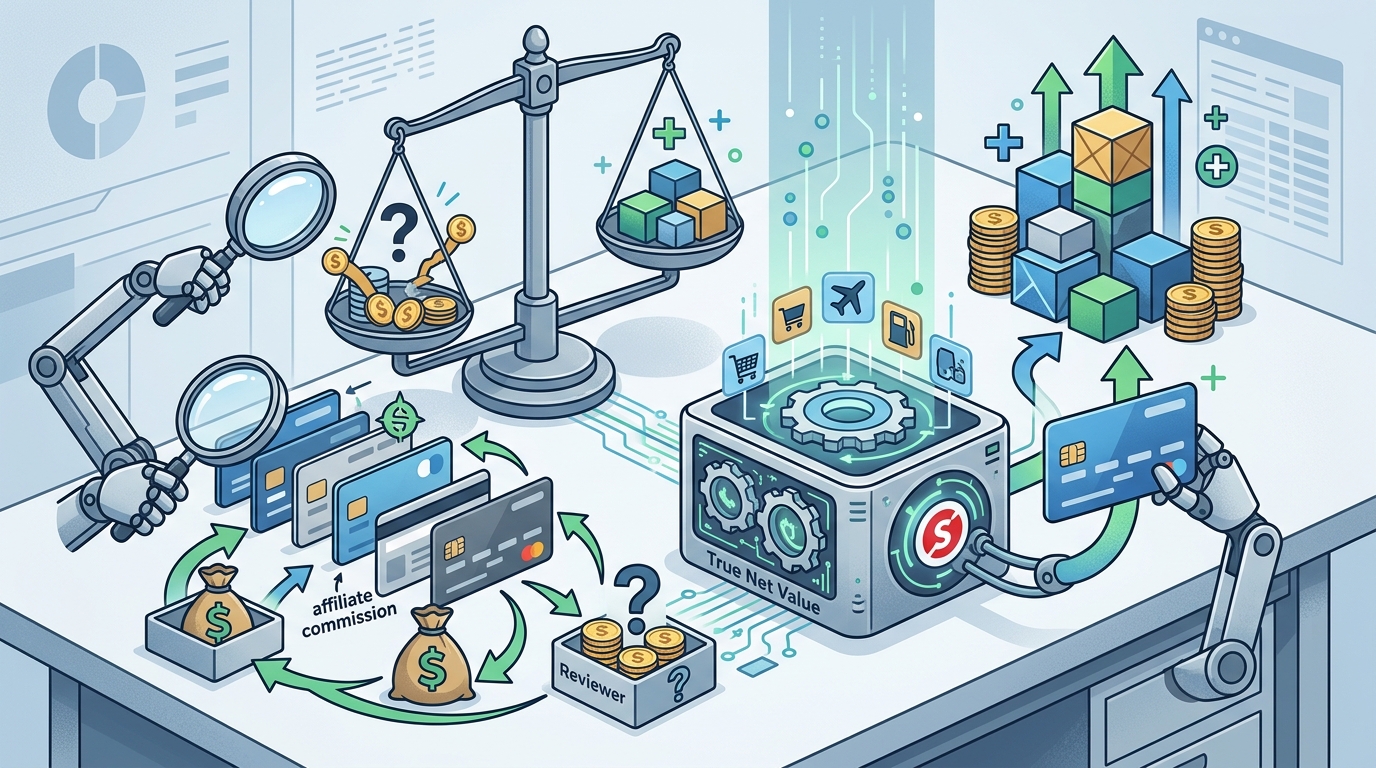
The conflict is subtle but real: when the platform earns more from Card A than Card B, the incentive is to feature Card A more prominently, even if Card B is better for you. Editorial firewalls help, but they cannot fully eliminate the structural tilt that affiliate revenue creates.
What "Unbiased" Actually Means
An unbiased recommendation is one where the advisor has no financial incentive tied to which specific product you choose. In financial planning, fiduciary advisors meet this standard by charging a flat fee or percentage of assets, never commissions from product providers.
The same principle applies to credit card tools. If the only money changing hands is a subscription fee from you to the service, there is no economic reason to steer you toward one issuer over another. The math wins, not the payout.
Three Signs of a Truly Unbiased Tool
- No affiliate links to card issuers anywhere on the platform
- No advertising or sponsored placements from banks
- Revenue comes exclusively from user subscriptions
How Credit Card Optimizers Work
A credit card optimizer is a software tool that analyzes your spending patterns and card portfolio to tell you which card to use for each purchase category in order to maximize rewards. The best optimizers go further: they model sign-up bonus progress, track annual-fee credits, flag program devaluations, and recommend when to open, downgrade, or close a card.
Tools in this space typically maintain large databases of card benefits. CardPointers, for instance, tracks category bonuses from over 5,000 credit cards across hundreds of banks. The depth of the card catalog matters because your optimal strategy depends on comparing your actual cards against the full universe of alternatives.
Real Transaction Data vs. Self-Reported Guesswork
Many tools ask you to estimate how much you spend on groceries, dining, or travel each month. The problem? People are terrible at self-reporting. A 2023 study by the Federal Reserve found that consumers routinely misclassify and undercount discretionary spending.
A better approach uses read-only bank connections through services like Plaid to pull your actual transaction history. savvX takes this route, connecting to your bank accounts through Plaid and analyzing real spending data against a curated catalog of 343 cards and 130+ transfer partners. The result is a recommendation grounded in what you actually buy, not what you think you buy.
Why Merchant-Code Accuracy Matters
Credit card issuers assign rewards based on merchant category codes (MCCs), not store names. A warehouse club might code as "grocery" on one card network and "wholesale" on another. Optimizers that read real transactions can see the actual MCC and match it to each card's bonus structure with precision.
Optimizer Business Models Compared
Understanding how each tool makes money reveals where potential bias lives. The table below compares the revenue models of popular credit card optimization platforms.
| Feature | savvX | NerdWallet | MaxRewards | CardPointers |
|---|---|---|---|---|
| Primary Revenue | User subscription only | Affiliate commissions | Freemium subscription + ads | Freemium subscription |
| Affiliate Card Links | None | Yes | Yes | Yes |
| Uses Real Transaction Data | Yes (via Plaid) | Limited | Yes (via Plaid) | Optional |
| Card Catalog Size | 343 cards, 130+ transfer partners | Hundreds (editorial reviews) | Hundreds | 5,000+ |
| Points Valuation Model | Personalized to your travel style | Editorial estimates | Standard valuations | Standard valuations |
| Annual-Fee Credit Tracking | Yes | No (editorial mentions only) | Yes | Yes |
| Sells User Data | No | First-party data for monetization | Not disclosed | Not disclosed |
The savvX Approach: Subscription-Only Revenue
savvX enforces a simple covenant: the only revenue is the user's subscription fee. There are no affiliate links, no card-issuer kickbacks, no ads, and no data sales. This business model means every recommendation is optimized for your rewards math, not for a referral payout.
Personalized Points Valuation
Most tools assign a flat cents-per-point value to each loyalty program. savvX models the true value of points based on how you personally travel. If you fly economy domestically, your Chase Ultimate Rewards points are worth a different amount than if you book international business class through Hyatt transfers. This personalized valuation changes which card is actually "best" for a given purchase.
Actionable Alerts
Beyond card-swipe guidance, savvX surfaces concrete actions: which sign-up bonus you are closest to earning, which annual-fee credits you are leaving on the table, when an issuer devalues a program you hold, and when to close or downgrade a card based on its real net value to you. You can review the service's commitment to data privacy and terms of service to see how user data is protected.
Key Takeaways
- Most credit card recommendation sites earn affiliate commissions from issuers, creating a structural conflict of interest.
- An unbiased optimizer charges only a subscription fee and never takes affiliate payments or sells user data.
- Real transaction data, pulled via read-only bank connections, produces far more accurate recommendations than self-reported spending estimates.
- Personalized points valuations based on your actual travel habits change which card is mathematically optimal for each purchase.
- savvX analyzes 343 cards and 130+ transfer partners with zero affiliate revenue, so its recommendations serve only you.
- Annual-fee credit tracking and program devaluation alerts prevent money from silently leaking out of your wallet.
- The subscription model aligns the tool's incentive with yours: the better your results, the more likely you are to keep paying.
Frequently Asked Questions
What is a credit card rewards optimizer?
A credit card rewards optimizer is a tool that analyzes your spending and card portfolio to recommend which card to use for every purchase in order to earn the maximum possible rewards.
Why do most card recommendation sites have affiliate bias?
Because they earn commissions when you apply for a card through their links. This means they have a financial incentive to promote cards with higher affiliate payouts, even if those cards are not the best fit for your spending.
How does savvX make money without affiliate links?
savvX charges a subscription fee. That is its only revenue source. It does not accept payments from card issuers, run ads, or sell user data. Learn more on the savvX pricing page.
Is it safe to connect my bank account through Plaid?
Plaid uses read-only, bank-level encryption to access transaction data. savvX cannot move money, open accounts, or make changes to your accounts. The connection is limited to viewing transaction history.
How many cards does savvX analyze?
savvX maintains a curated catalog of 343 credit cards and over 130 transfer partners, covering the major U.S. issuers and loyalty programs.
What does "personalized points valuation" mean?
Personalized points valuation is the practice of calculating what your loyalty points are actually worth based on how you redeem them. Instead of using a generic "1.5 cents per point" headline figure, savvX models your real travel patterns to determine the true dollar value of each point in your portfolio.
Can an optimizer help me decide when to cancel a card?
Yes. A good optimizer tracks each card's annual fee against the value of its credits, rewards, and perks. When a card's net value turns negative for your usage pattern, the tool alerts you to downgrade or close it.
Do I need a lot of credit cards to benefit?
No. Even with two or three cards, an optimizer can identify which one to use at each merchant and whether a new card's sign-up bonus would be worth pursuing based on your real spending.
Start Optimizing Your Rewards Today
If you are tired of wondering whether your card recommendations are designed to help you or to generate affiliate revenue for someone else, it is time to try an optimizer that works exclusively for you. Visit savvX to connect your accounts, see which card you should be swiping at every merchant, and start earning what your spending actually deserves.