

Credit Card Transaction Analysis Tools You Can Actually Trust
Most people use the wrong credit card for at least some of their purchases, and they never realize it. The difference between swiping a flat-rate 2% card and using the right category card at the right merchant can add up to hundreds of dollars a year in missed rewards. A credit card transaction analysis tool is software that reads your real spending data, maps it against card reward structures, and tells you which card to use and when. But not every tool earns your trust equally. Some make money from card issuers, which quietly tilts the advice. Here is how to evaluate these tools and find one that genuinely works for you.
Why You Need a Transaction Analysis Tool
Credit card rewards programs are more complex than ever. Rotating bonus categories, quarterly caps, merchant-specific multipliers, and transfer-partner valuations make it nearly impossible to optimize manually. According to industry data, rewards credit cards vary in the types of rewards they offer and how those rewards are structured, from points and miles to tiered cash back.
If you carry more than two cards, you are almost certainly leaving value on the table. A tool that reads your actual transactions removes the guesswork and tells you which credit card to use at checkout for every single purchase.
How Credit Card Analysis Tools Work
Bank Connection via Plaid
Most modern analyzers connect to your bank accounts through Plaid. Plaid is a financial technology company that provides secure, read-only infrastructure connecting consumer apps to banks. It uses token-based authentication and advanced encryption so your login credentials are never shared with the connected app. According to Norton, Plaid is certified under ISO 27001 and ISO 27701, internationally recognized data-security standards.
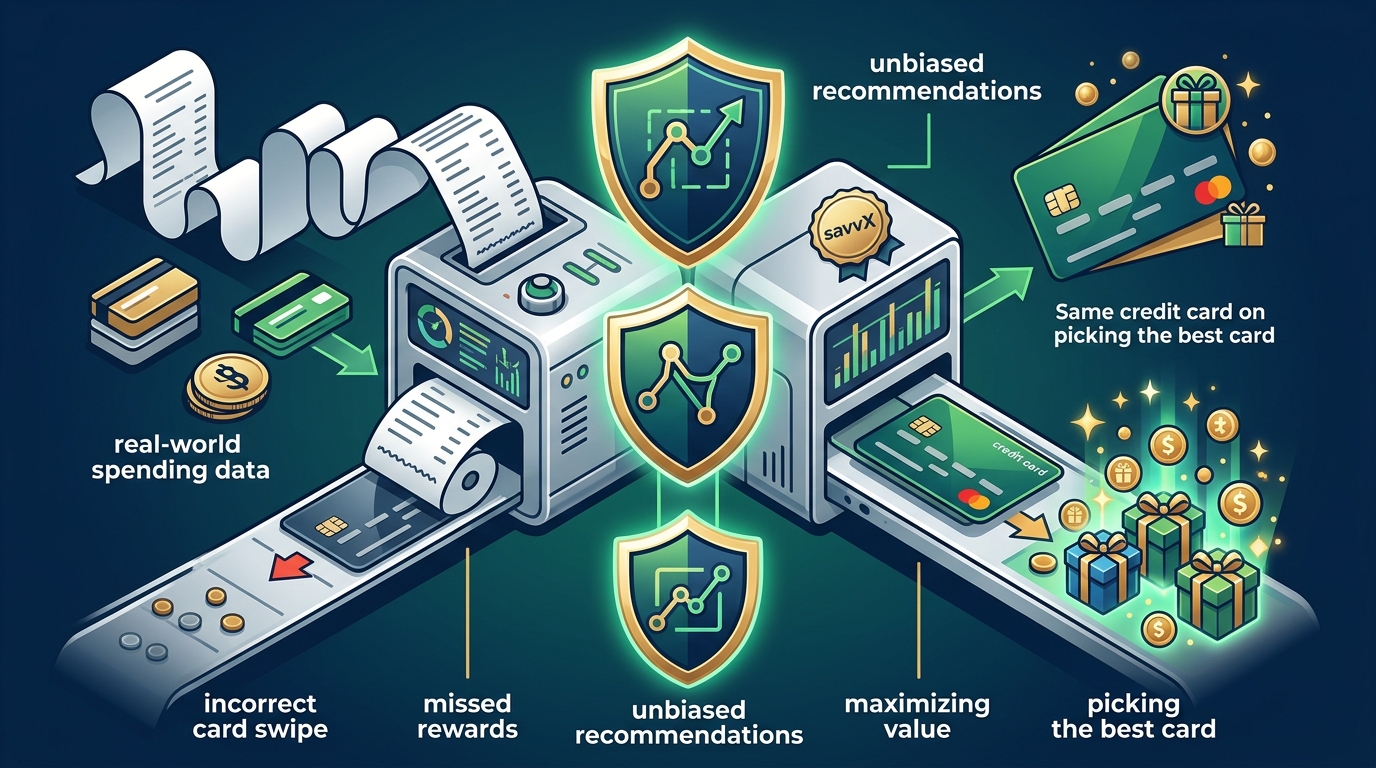
Transaction Categorization and Matching
Once connected, the tool categorizes each transaction by merchant and spending category, then compares your actual spend against the reward rates of cards you hold and cards you could hold. The best tools go further by modeling the real value of points based on transfer partners and redemption methods, not just headline portal rates.
Actionable Output
A good optimizer does not just show you data. It tells you which card to swipe at which store, which sign-up bonus you are closest to earning, and which annual-fee credits you are leaving unused. Learn more about rewards you may be leaving on the table.
The Trust Problem With Free Card Recommendations
Many popular card-recommendation sites earn revenue through affiliate links. An affiliate link is a tracked URL that pays the referring site a commission when you apply for a card. This creates a conflict of interest: the site may rank a card higher because it pays a larger commission, not because it is the best fit for your spending.
Even well-intentioned sites disclose this. Bankrate, for example, notes it is "compensated in exchange for placement of sponsored products." That does not make their content bad, but it does mean the recommendations are not purely math-driven for your wallet. If you want advice you can fully trust, unbiased credit card optimization requires a different business model entirely.
What to Look for in a Trustworthy Optimizer
Revenue Transparency
Ask one question: how does the tool make money? If the answer is affiliate commissions or data sales, the recommendations may be skewed. A subscription-only model aligns the tool's incentives with yours.
Real Transaction Data, Not Self-Reported Estimates
Tools that ask you to estimate your spending in broad categories will always be less accurate than tools that read your actual bank transactions. Real data catches spending patterns you might overlook, like how much you really spend on dining versus groceries.
Breadth of Card Catalog
The tool should compare your spending against a large, regularly updated database of cards. Savvx, for instance, analyzes your real spending against a curated catalog of 343 cards and 130+ transfer partners to surface the best credit card for your purchases.
How Savvx Analyzes Your Spending Without Bias
Savvx is a subscription credit card optimization service that connects to your bank accounts through Plaid in read-only mode. It earns zero revenue from card companies. Your subscription is its only revenue, which is the only way to guarantee that recommendations are purely math-driven.
Here is what Savvx does with your data:
- Identifies the optimal card for every merchant in your transaction history
- Models true point values based on how you actually travel, not portal averages
- Alerts you to sign-up bonuses you are close to earning
- Flags annual-fee credits you have not yet redeemed
- Advises when to close, downgrade, or keep a card based on its real net value
Savvx also offers a Smart Wallet Chrome extension that shows a recommendation banner on any merchant website you visit while shopping online. It even auto-syncs your rewards balances and statement credits.
Explore how to maximize credit card rewards by spending and learn the best way to redeem your credit card points.
Feature Comparison: Key Criteria at a Glance
| Criteria | Affiliate-Based Sites | Self-Report Calculators | Savvx |
|---|---|---|---|
| Revenue source | Card-issuer commissions | Ads / affiliate links | User subscription only |
| Data input | Manual quizzes | Self-estimated categories | Real bank transactions via Plaid |
| Card catalog size | Varies (commission-paying cards) | Limited presets | 343 cards, 130+ transfer partners |
| Point valuation method | Headline rates | Portal averages | Personalized by your travel style |
| Which-card-to-swipe alerts | No | No | Yes (app + Chrome extension) |
| Annual-fee credit tracking | Rare | No | Yes |
| Data sold to third parties | Often | Sometimes | Never |
Key Takeaways
- A credit card transaction analysis tool removes guesswork by reading your real spending data.
- Affiliate-funded recommendation sites face inherent conflicts of interest that can skew suggestions.
- Plaid provides secure, read-only bank connections certified under ISO 27001 and ISO 27701.
- The most trustworthy optimizers earn revenue only from user subscriptions, not card-issuer kickbacks.
- Savvx analyzes 343 cards and 130+ transfer partners against your actual transactions.
- Real point valuations should reflect how you travel, not generic portal redemption rates.
- Tools that track annual-fee credits and sign-up bonus progress deliver the most complete value.
Frequently Asked Questions
What is a credit card transaction analysis tool?
A credit card transaction analysis tool is software that connects to your bank accounts, reads your purchase history, and recommends which card to use for each spending category to maximize your rewards.
Is it safe to connect my bank account through Plaid?
Yes. Plaid connections are read-only by default, meaning they cannot move money or change your account settings. Plaid uses advanced encryption, multi-factor authentication, and is certified under ISO 27001 and ISO 27701.
How does Savvx make money if it does not use affiliate links?
Savvx earns revenue exclusively from user subscriptions. It takes no affiliate payments from credit card companies and does not sell user data. See Savvx pricing for details.
Can a tool like this actually save me money?
Yes. By ensuring you always use the highest-earning card at every merchant and by tracking annual-fee credits and sign-up bonuses, users often recover significantly more than the cost of a subscription.
Does Savvx work with all credit cards?
Savvx maintains a curated catalog of 343 cards covering major issuers like Chase, Amex, Citi, Capital One, and more, along with 130+ transfer partners for points-based programs.
What if I only have one or two credit cards?
Savvx still helps by identifying whether a different card would earn you more based on your real spending, and it tracks your existing card's benefits so you do not miss annual-fee credits or bonus categories.
How is this different from a budgeting app?
Budgeting apps like YNAB or Monarch Money track where your money goes. A credit card optimizer like Savvx tells you which card to use before you spend, so you earn the maximum possible rewards on every purchase.
Can I disconnect my bank account at any time?
Yes. You can revoke Plaid access at any time through your Savvx settings or directly through the Plaid consumer portal.
Start Maximizing Your Rewards Today
Stop wondering whether you are using the right card. Connect your accounts on Savvx and get personalized, unbiased recommendations backed by your real spending data, not affiliate commissions. Your wallet will thank you.