

Earning credit card points is only half the equation. The real payoff comes when you redeem them wisely. Yet most cardholders leave significant value on the table by cashing out at the lowest possible rate or letting points sit idle while programs quietly devalue them. This guide walks you through every major redemption method, ranks them by cents-per-point value, and shows you how to build a system that automatically surfaces your best move. Whether you hold Chase Ultimate Rewards, Amex Membership Rewards, or any of the other major currencies, you will finish this article knowing exactly how to squeeze more from every point you have earned.
Understanding What Your Points Are Actually Worth
A credit card point is a unit of rewards currency issued by your card provider, redeemable for travel, cash, merchandise, or gift cards. The critical insight most people miss is that the same point can be worth anywhere from 0.5 cents to over 5 cents depending on how you redeem it.
For example, Bankrate notes that travel redemptions and transfers to airline or hotel partners generally deliver the highest value. Meanwhile, redeeming for merchandise or gift cards often yields less than 1 cent per point. Understanding this spread is the foundation of any smart redemption strategy.
Why Point Values Fluctuate
Programs like Chase Ultimate Rewards, Amex Membership Rewards, Citi ThankYou, Capital One Miles, and Bilt Rewards each set their own redemption rates. A point redeemed through a travel portal might be worth 1.25 to 1.5 cents, while the same point used for an Amazon checkout could drop to 0.7 cents. Redemption context is everything.
Redemption Methods Ranked by Value
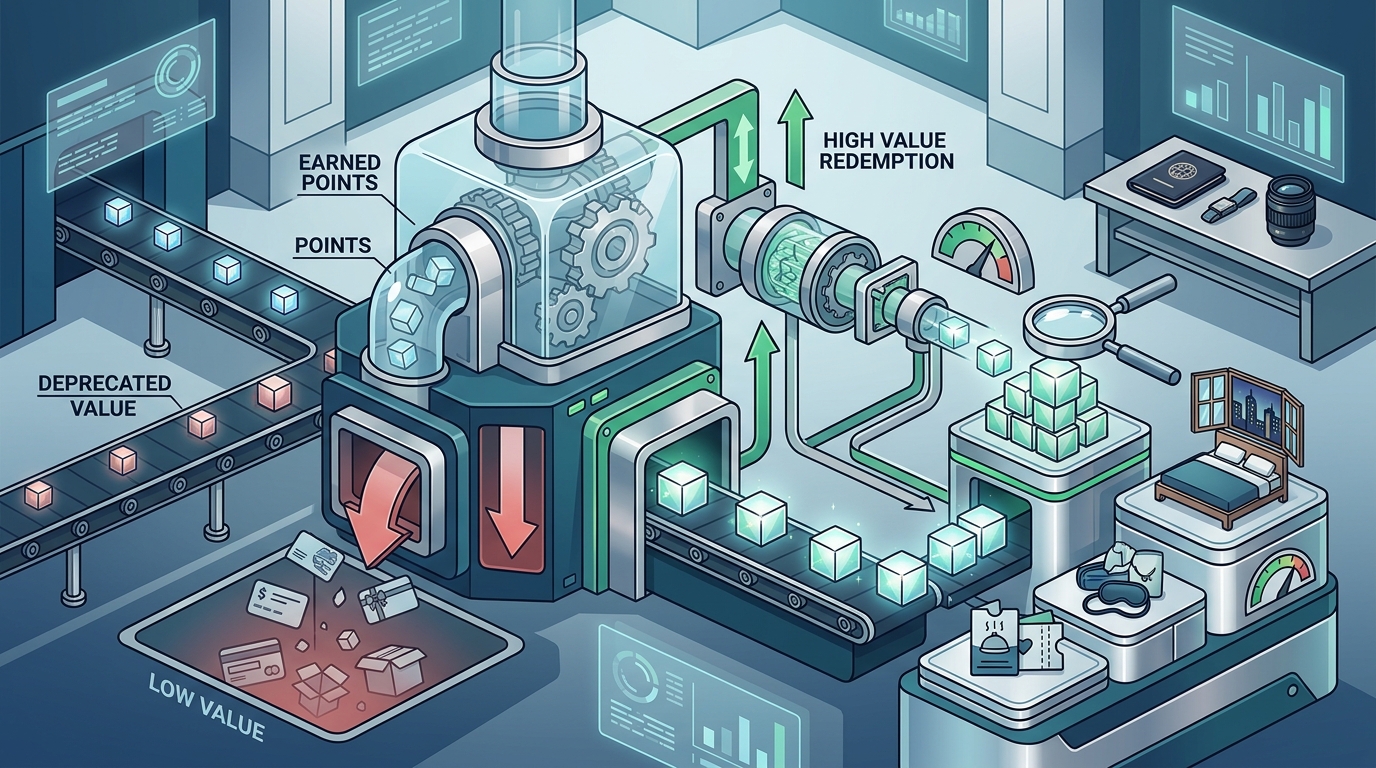
Not all redemptions are created equal. Here is how the most common options typically stack up in terms of cents per point (cpp).
| Redemption Method | Typical Value (cpp) | Best For |
|---|---|---|
| Transfer to airline/hotel partner | 1.5 - 5.0+ | Premium cabin flights, aspirational hotel stays |
| Issuer travel portal | 1.0 - 1.5 | Straightforward travel bookings |
| Statement credit / cash back | 0.5 - 1.0 | Simplicity, non-travelers |
| Gift cards | 0.5 - 1.0 | Specific retailer spending |
| Merchandise / Pay with Points | 0.3 - 0.7 | Convenience (not recommended) |
The pattern is clear: the more effort you put into choosing a redemption path, the more value you extract. Transfer partners sit at the top because award charts sometimes price flights far below their cash cost, especially in business and first class.
Transfer Partners: The Highest-Value Play
A transfer partner is an airline or hotel loyalty program that accepts points from your credit card issuer, typically at a 1:1 ratio. Chase, Amex, Citi, Capital One, and Bilt all maintain networks of transfer partners. Savvy redeemers look for "sweet spot" awards where the points required are dramatically less than the cash price of the ticket or stay.
Examples of High-Value Transfers
Transferring Chase points to Hyatt for hotel stays often yields 2 cents per point or more. On the airline side, moving Amex points to ANA for a round-trip business class flight to Tokyo can return over 5 cpp. These are not theoretical numbers; they are routinely documented by the points-and-miles community.
How savvX Helps You Find the Best Transfer
Tracking 130+ transfer partners manually is impractical. savvX models the true value of your points based on how you actually travel, not generic portal valuations. Because savvX earns zero from card companies, the recommendations optimize for your math, not an affiliate payout.
Booking Through Travel Portals
If transferring points feels too complex, issuer travel portals are the next best option. Chase, Amex, Citi, and Capital One each operate booking portals where your points have a fixed or boosted redemption rate. Chase Sapphire Reserve cardholders, for instance, get 1.5 cents per point when booking through Chase Travel.
The trade-off is flexibility. Portal bookings are straightforward but rarely match the outsized value you can unlock through transfer partners on premium redemptions. For everyday domestic flights or standard hotel rooms, portals deliver solid, predictable returns.
Cash Back and Statement Credits
Cash back is the simplest redemption: one point equals a fixed number of cents deposited to your account. A statement credit is a dollar-amount reduction applied directly to your card balance. Both are easy to understand but usually cap out at 1 cent per point or less.
If you consistently prefer cash redemptions, consider whether a dedicated cash-back card might earn you more than a travel card redeemed at a discount. Tools like savvX can analyze your actual transactions and tell you whether you would net more with a flat-rate cash card versus a travel card you never fully optimize.
Common Pitfalls That Destroy Point Value
Redeeming for Merchandise
Pay-with-points checkouts at retailers like Amazon often value your points at just 0.7 cents each. That means 10,000 hard-earned Amex points buy only $70 of merchandise instead of $150 or more in travel value. Avoid this unless you have no other use for your points.
Hoarding Too Long
Points do not appreciate over time. Programs regularly devalue their currencies by raising award prices or removing transfer partners. If you are sitting on a large balance without a plan, you are exposed to devaluation risk. Use them or have a clear target.
Ignoring Annual-Fee Credits
Many premium cards include statement credits for travel, dining, or streaming that effectively reduce the annual fee. Missing these credits is the same as overpaying for the card. savvX tracks these for you and alerts you before credits expire.
How to Automate Your Redemption Strategy
Keeping track of point balances, transfer ratios, award chart changes, and annual-fee credits across multiple cards is a part-time job. This is where automation becomes essential.
savvX connects to your bank accounts through Plaid (read-only) and continuously analyzes your real spending across a catalog of 343 cards and 130+ transfer partners. It tells you which card to swipe at every merchant, flags sign-up bonuses you are close to earning, and alerts you to program devaluations. The service runs on a subscription model with no affiliate links, no card-issuer kickbacks, and no data sales, so every recommendation is aligned with your interests alone.
Automating your strategy means you never accidentally waste points on a low-value redemption or miss a high-value transfer window.
Key Takeaways
- Transfer partners consistently deliver the highest cents-per-point value, often 2x to 5x more than cash back.
- Issuer travel portals are a reliable middle ground, especially for straightforward bookings.
- Cash back and statement credits are simple but typically cap at 1 cent per point.
- Merchandise and pay-with-points checkouts are almost always the worst redemption option.
- Points do not gain value over time; program devaluations are a real and recurring risk.
- Annual-fee credits are effectively free money you should never leave unclaimed.
- Automating your card and redemption strategy with a tool like savvX removes guesswork and protects you from costly mistakes.
Frequently Asked Questions
What is the single best way to redeem credit card points?
Transferring points to airline or hotel loyalty partners generally yields the highest value, especially for premium cabin flights and aspirational hotel stays where cash prices are steep.
How much are credit card points worth in dollars?
It depends on the program and redemption method. A common baseline is 1 cent per point, but travel transfers can push value above 2 cents and sometimes past 5 cents per point.
Should I use points for cash back or travel?
Travel redemptions almost always deliver more value per point. However, if you rarely travel, a flat-rate cash-back card may be a better fit than a travel card redeemed at a discount.
Do credit card points expire?
Most major programs (Chase, Amex, Capital One) do not expire points while your account remains open. However, some co-branded and smaller programs do impose expiration dates, so always check your terms.
What are transfer partners?
Transfer partners are airline and hotel loyalty programs that accept points from credit card issuers, typically at a 1:1 ratio. Chase, Amex, Citi, Capital One, and Bilt each maintain their own partner networks.
How does savvX help me redeem points better?
savvX analyzes your real spending data across 343 cards and 130+ transfer partners to surface the highest-value redemption paths. It runs entirely on subscription revenue with zero affiliate payments, ensuring unbiased recommendations.
Is it better to save points or use them right away?
Generally, use them when you have a high-value redemption available. Points do not appreciate, and programs routinely devalue their currencies by raising award prices.
What is a good cents-per-point target?
Aim for at least 1.5 cents per point on travel redemptions. If you can find sweet-spot transfers yielding 2 cpp or higher, you are doing better than the vast majority of cardholders.
Stop Leaving Points on the Table
Your credit card points are only as valuable as the redemption you choose. Start your savvX subscription today to see exactly how much value you are missing and get personalized, unbiased guidance on every redemption decision.