

Best Way to Redeem Credit Card Points for Maximum Value
You have been swiping the right cards and stacking points for months. Now the big question lands: how do you actually redeem those points so you are not leaving money on the table? The answer is not the same for everyone. It depends on the cards you hold, how you travel, and whether you prefer simplicity or are willing to do a little homework for outsized returns. In this guide we break down every major redemption channel, show you how to calculate the real value of your points, and explain how tools built on your actual spending data can remove the guesswork entirely.
Understand What Your Points Are Actually Worth
A credit card point is a unit of rewards currency whose cash-equivalent value changes depending on the issuer and how you redeem it. According to Bankrate, most credit card rewards are worth roughly 1 cent per point at baseline. But that number swings wildly once you factor in redemption method.
To calculate the cents-per-point (CPP) value of any redemption, divide the dollar value of the booking or credit by the number of points required. For example, a hotel room priced at $200 that costs 20,000 points delivers exactly 1.0 CPP. If the same room costs 10,000 points through a transfer partner, you are getting 2.0 CPP, double the value.
Why Headline Valuations Mislead
Many sites publish average point valuations, such as the 2.05 CPP figure The Points Guy assigns to Chase Ultimate Rewards. Those numbers reflect best-case transfer redemptions, not what most cardholders actually achieve. Your real value depends on the routes you fly, the hotels you book, and the dates you travel.
Transfer Partners: The High-Value Play
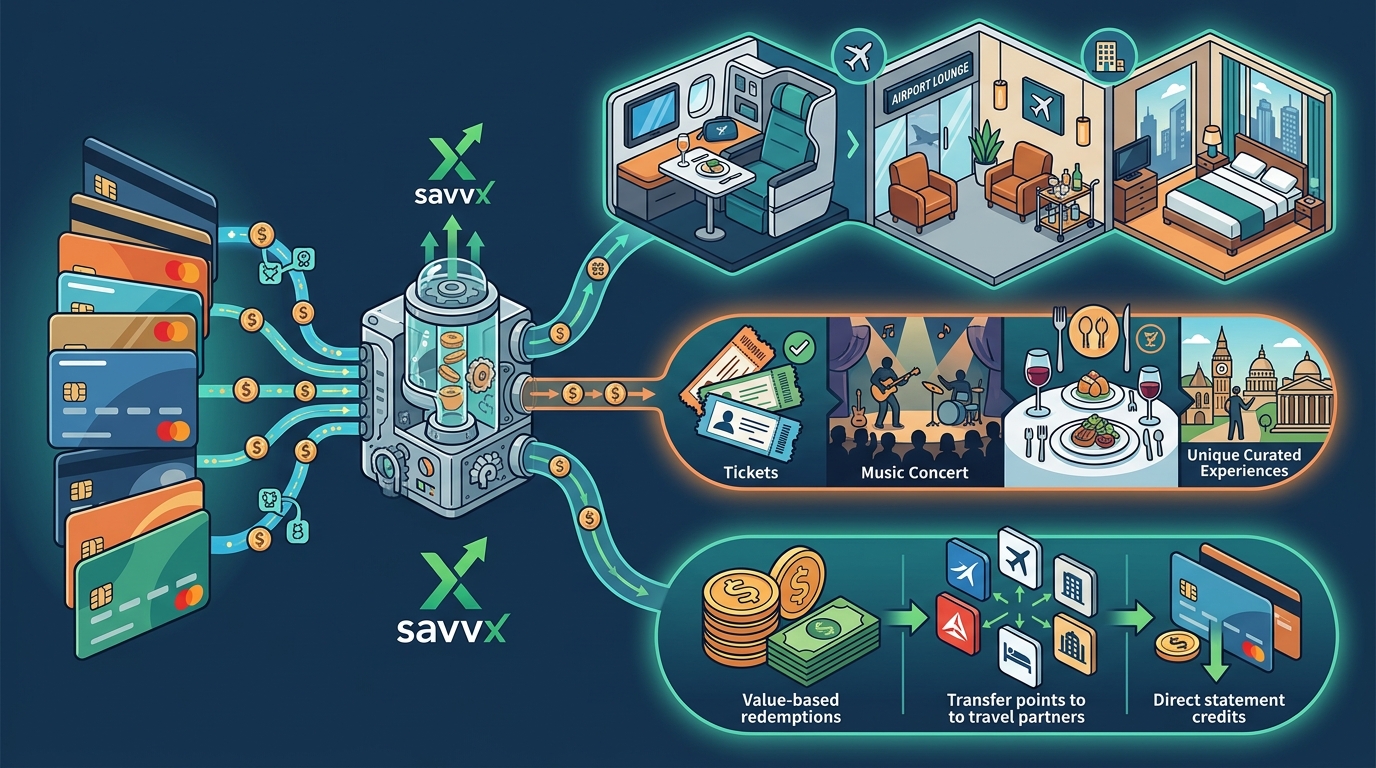
A transfer partner is an airline or hotel loyalty program that accepts points converted from your credit card issuer, usually at a 1:1 ratio. Chase, Amex, Capital One, and Citi each maintain rosters of 10 to 20+ partners. When award availability lines up, transfers regularly deliver 1.5 to 3+ CPP, far above any portal or cash-back rate.
How to Evaluate a Transfer
Start by searching award availability on the partner airline or hotel site. Compare the points required against the cash price of the same booking. If the CPP exceeds your program's baseline (typically 1.0 to 1.25 cents), the transfer is worth it. If it falls below, book through a portal or take cash back instead.
Watch for Devaluations
Loyalty programs can change award charts at any time. Leaving rewards on the table while a program quietly raises prices is one of the most common ways people lose value. Monitoring devaluations is essential, and it is one of the reasons savvX tracks program changes for every card in its catalog of 343 cards and 130+ transfer partners.
Booking Through Travel Portals
A travel portal is a booking engine operated by your card issuer (such as Chase Travel or the Amex Travel portal) where you can spend points at a fixed rate. Portal redemptions are simpler than transfers and often deliver 1.0 to 1.5 CPP depending on your card tier.
| Redemption Method | Typical CPP Range | Complexity | Best For |
|---|---|---|---|
| Airline/Hotel Transfer | 1.5 - 3.0+ | High | Premium-cabin flights, aspirational hotel stays |
| Issuer Travel Portal | 1.0 - 1.5 | Low | Straightforward flight and hotel bookings |
| Cash Back / Statement Credit | 0.5 - 1.0 | Very Low | Non-travelers, debt paydown |
| Gift Cards | 0.5 - 1.0 | Low | Specific retailers only |
| Merchandise / Amazon Checkout | 0.3 - 0.8 | Low | Avoid if possible |
The table above illustrates why the same 50,000 points can be worth anywhere from $150 to $1,500 depending on how you use them. Choosing the wrong channel is the single biggest leak in most people's rewards strategy.
Cash Back and Statement Credits
Cash back is a rewards redemption where points are converted directly into dollars, usually as a statement credit or bank deposit. It is the simplest option and guarantees a known value. Most programs pay 1 cent per point for cash redemptions, though some premium cards offer a slight bump when the credit is applied against travel charges.
Cash back makes sense if you do not travel frequently, if you carry a balance you want to pay down, or if you simply value certainty. There is nothing wrong with choosing the guaranteed dollar over a speculative 2 CPP transfer you might never book. The key is making that choice deliberately, not by default.
Low-Value Redemption Traps to Avoid
Redeeming points for merchandise through an issuer catalog almost always returns less than 1 cent per point. The same goes for paying with points at Amazon checkout, which typically values each point at around 0.7 to 0.8 cents. Gift card redemptions vary, but they rarely beat cash back.
Expiration and Devaluation Risk
Points sitting idle are losing potential value. Programs can devalue award charts, and some points expire after periods of account inactivity. Maximizing rewards by aligning spending with the right card only pays off if you also redeem intelligently before the value erodes.
Using Real Spending Data to Pick the Right Redemption
Generic advice can only take you so far. The optimal redemption depends on the specific cards in your wallet, the points balances you hold, and how you actually travel. This is where a data-driven approach outperforms guesswork.
savvX connects to your bank accounts through read-only Plaid access and analyzes your real transaction data against its catalog of 343 cards and 130+ transfer partners. Instead of relying on generic CPP charts, savvX models the true value of your points based on how you personally travel. It surfaces concrete actions: which transfer partner gives you the best return for your specific upcoming trip, which annual-fee credits you have not claimed, and when a program you hold gets devalued.
Critically, savvX is funded solely by your subscription fee. It takes zero revenue from card companies, no affiliate links, no issuer kickbacks, no ads, and no data sales. That means its redemption recommendations optimize for your math, not someone else's payout.
Key Takeaways
- Always calculate cents-per-point before redeeming. Divide the dollar value by points required.
- Transfer partners consistently offer the highest value (1.5 to 3+ CPP) but require more planning.
- Travel portals are a solid middle ground at 1.0 to 1.5 CPP with minimal effort.
- Cash back is not a waste if it matches your lifestyle; just make sure you are choosing it, not defaulting into it.
- Avoid merchandise catalogs and Amazon checkout redemptions, which typically return under 0.8 CPP.
- Monitor program devaluations so your banked points do not silently lose value.
- Tools like savvX that use your actual purchase data remove guesswork and surface the highest-value redemption for your specific situation.
Frequently Asked Questions
What is the best way to redeem credit card points?
The best way depends on your goals. Transferring points to airline or hotel partners typically yields the highest cents-per-point value (1.5 to 3+ CPP). If you prefer simplicity, booking through your issuer's travel portal or taking cash back are reliable alternatives.
How do I calculate how much my credit card points are worth?
Divide the dollar value of the redemption by the number of points required. A $300 flight that costs 15,000 points delivers 2.0 cents per point. Compare that figure against your program's baseline to decide if the redemption is worthwhile.
Is it better to use points for travel or cash back?
Travel redemptions, especially through transfer partners, almost always return more value per point. However, cash back offers certainty and flexibility. If you rarely travel, cash back at 1 CPP beats letting points sit and risk devaluation.
What are credit card transfer partners?
Transfer partners are airline and hotel loyalty programs that accept points converted from your credit card issuer. For example, Chase Ultimate Rewards transfers 1:1 to partners like United, Hyatt, and Southwest, often unlocking redemptions well above 1 cent per point.
Do credit card points expire?
It depends on the program. Most major bank-issued points (Chase, Amex, Capital One) do not expire as long as your account is open. However, points transferred to airline or hotel programs may expire after 12 to 24 months of inactivity.
Why should I avoid redeeming points for merchandise?
Issuer merchandise catalogs and Amazon checkout redemptions typically value each point at 0.3 to 0.8 cents, far below what you can get through travel or even cash back. It is almost always a losing trade.
How does savvX help me redeem points for more value?
savvX analyzes your real spending and travel patterns against 343 cards and 130+ transfer partners. Because it earns revenue only from your subscription, with no affiliate links or issuer payments, its recommendations focus purely on maximizing your personal return.
Can I combine points from multiple credit cards?
Some issuers allow pooling. Chase lets you transfer points between eligible personal cards, and household pooling is available with certain airline programs after points are transferred. Consolidating balances can help you reach high-value award thresholds.
Start Optimizing Your Redemptions Today
Stop guessing which redemption channel gives you the best return. Try savvX and let your real spending data reveal exactly how to squeeze maximum value from every point in your wallet. No affiliate links. No issuer kickbacks. Just the math that works for you.