

Best Credit Card for Every Purchase: How to Maximize the Points You Actually Earn
There is no single best credit card for every person. The right card depends on where you spend, how you redeem, and whether your wallet is set up to capture the highest return on each transaction. Americans earned roughly $47 billion in credit card rewards in 2024, yet left around $3 billion unredeemed. Much of that gap comes from using the wrong card at the wrong merchant. This guide breaks down exactly how to match each purchase to the card that earns the most points, and how tools like savvX automate that decision using your real spending data.
Why One Card Is Never Enough
Most rewards cards use tiered structures: higher earn rates in specific categories and a lower base rate on everything else. A card that earns 4x on dining gives you just 1x on groceries. If you only carry one card, you leave points on the table every time you buy outside its bonus categories.
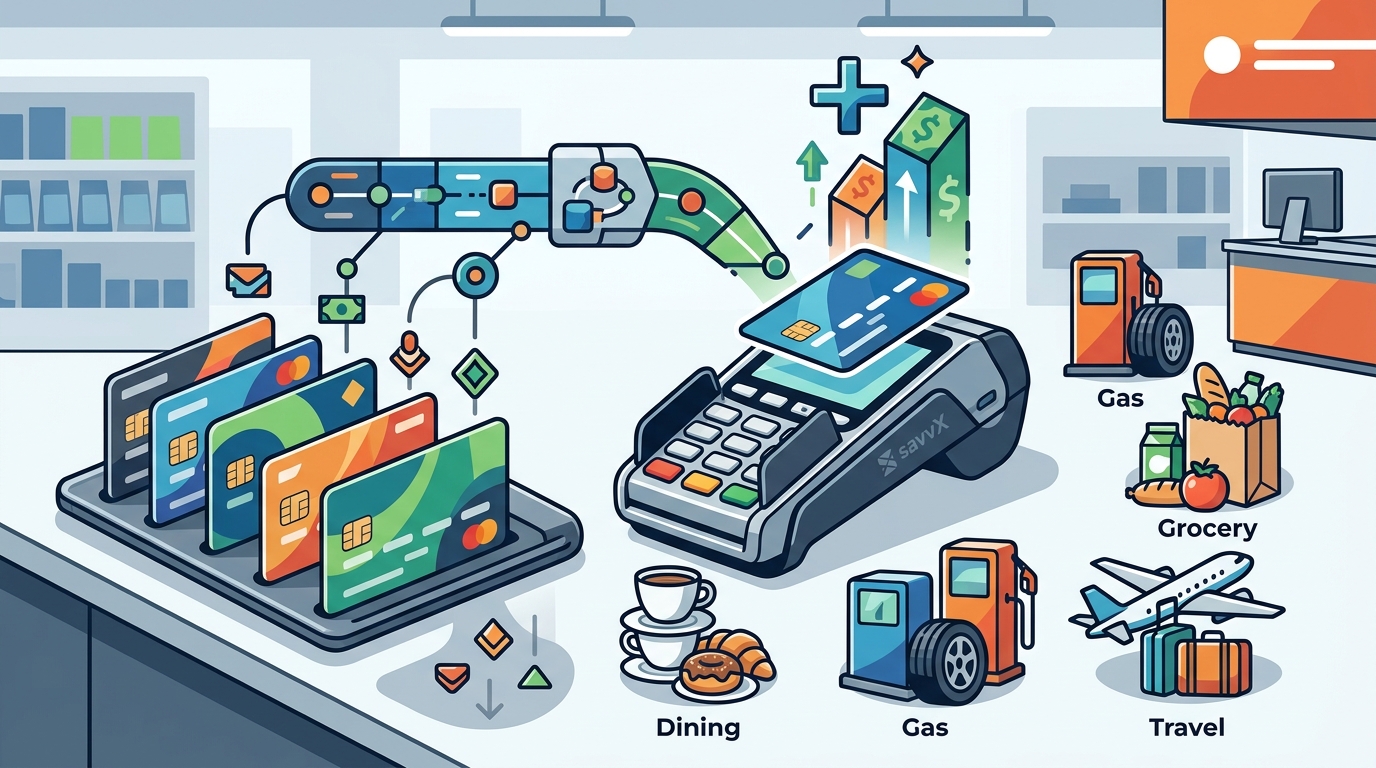
The solution is a multi-card strategy. Pairing two or three cards lets you cover dining, groceries, travel, gas, and general spending at elevated rates. The challenge is remembering which card to pull out at each merchant, a problem that savvX solves at checkout by telling you the optimal card in real time.
Understanding Reward Types: Points, Miles, and Cash Back
Points
Points are flexible reward units issued by banks such as Chase (Ultimate Rewards), Amex (Membership Rewards), and Citi (ThankYou Points). Points is a currency whose value depends entirely on how you redeem it. Transferred to airline partners, a point can be worth 1.5 to 2.5 cents; cashed out, it is often worth just 1 cent.
Miles
Miles are loyalty credits tied to a specific airline or a bank travel program. Cards like the Capital One Venture earn miles redeemable against travel purchases or transferable to partners.
Cash Back
Cash back is a percentage of each purchase returned directly as a statement credit or deposit. It is the simplest reward type, with no transfer complexity and a fixed value per dollar spent.
Category-by-Category Card Strategy
The table below shows common spending categories and the types of cards that typically deliver the highest earn rate in each.
| Spending Category | Top Earn Rate (2026) | Example Card Type | Base Rate Without Bonus |
|---|---|---|---|
| Dining | 4x-5x points | Premium travel card (Amex Gold, Sapphire) | 1x |
| Groceries | 4x-6% back | Amex Gold or Blue Cash Preferred | 1x-1% |
| Travel / Flights | 3x-5x points | Premium travel card or airline co-brand | 1x |
| Gas / EV Charging | 3x-4x | U.S. Bank Altitude Connect, rotating cards | 1x |
| Online Shopping | 3x-5x (rotating) | Chase Freedom Flex, Discover it | 1x-1.5x |
| Everything Else | 2% flat | Flat-rate cash-back card (Wells Fargo Active Cash, Citi Double Cash) | 1% |
The key is mapping your actual transactions to these categories. Many merchants code differently than you expect. A food-delivery app might code as "online services," not dining. savvX uses real transaction data from your linked accounts to classify each merchant correctly, so your recommendations reflect reality, not assumptions.
Why Real Transaction Data Beats Guesswork
Most card-comparison sites ask you to estimate how much you spend per category. Those self-reported numbers are notoriously inaccurate. People overestimate dining and underestimate subscriptions. The result: you pick a card optimized for a spending pattern you do not actually have.
savvX takes a different approach. It connects to your bank accounts through Plaid in read-only mode, analyzes your actual transactions, and compares them against a catalog of 343 credit cards. Because savvX earns revenue only from your subscription fee, with no affiliate links, no card-issuer kickbacks, and no data sales, every recommendation is purely math-driven.
Transfer Partners and True Point Values
A transfer partner is an airline or hotel loyalty program that accepts points from your bank's rewards currency, often at a 1:1 ratio. Chase Ultimate Rewards, for example, transfers to United, Hyatt, Southwest, and more. Amex Membership Rewards connects to over 20 airlines and hotels.
The true value of a point depends on how you redeem. Booking a Hyatt award night can yield 2 cents or more per point. Redeeming through a generic portal might give you only 1 cent. savvX models point values based on how you actually travel, not headline rates, across 130+ transfer partners.
Why This Matters for Card Selection
If you fly Delta twice a year, an Amex card that transfers to Delta at strong rates may beat a Chase card, even if Chase's base earn rate looks higher on paper. Your redemption behavior determines the card's real return.
Hidden Value: Credits, Bonuses, and Fee Offsets
Annual-Fee Credits
Premium cards often include statement credits for dining, travel, streaming, or airline incidentals. These credits can offset most or all of a card's annual fee, but only if you use them. According to LendingTree, 40% of rewards cardholders did not redeem any rewards in the past year.
Sign-Up Bonuses
A sign-up bonus is a one-time reward issued after you meet a minimum spending threshold within a set period. These bonuses can be worth $500 to $1,000+ in travel value and often dwarf ongoing earn rates for the first year. savvX tracks which bonuses you are closest to earning and flags credits you are leaving on the table.
When to Keep, Downgrade, or Close
A card with a $550 annual fee is worth keeping only when its credits, earn rate, and perks return more than $550 in value you actually use. savvX calculates each card's real net value every month and recommends whether to keep, downgrade to a no-fee version, or close the account.
Key Takeaways
- No single card maximizes rewards on every purchase; a two- or three-card strategy covers more categories at higher rates.
- Americans left roughly $3 billion in rewards unredeemed in 2024, largely because of poor card selection and forgotten credits.
- Self-reported spending estimates lead to wrong card picks; real transaction data produces accurate recommendations.
- Transfer-partner redemptions can double or triple the value of a point compared to cash-out options.
- Annual-fee credits often go unused, turning a profitable card into a net loss.
- savvX analyzes 343 cards and 130+ transfer partners using your actual spending, funded only by your subscription, never affiliate revenue.
- The right card changes over time as your spending shifts and issuers update bonus categories.
Frequently Asked Questions
What is the single best credit card for earning points?
There is no universal best card. The optimal choice depends on your personal spending mix. A card that earns 4x on dining is ideal for restaurant-heavy spenders but suboptimal if most of your budget goes to groceries or gas. Tools like savvX match cards to your real transactions.
How many credit cards should I carry to maximize rewards?
Two to four cards typically cover the major bonus categories (dining, groceries, travel, and a flat-rate catch-all). Adding more than four creates diminishing returns and tracking complexity.
Do rewards credit cards charge annual fees?
Some do. Premium cards like the Chase Sapphire Reserve ($550) and Amex Gold ($325) charge annual fees but offset them with credits, lounge access, and higher earn rates. Many flat-rate cash-back cards charge $0.
How does savvX differ from free card-recommendation sites?
Most free comparison sites earn affiliate commissions from card issuers, which can bias their rankings. savvX charges a subscription fee as its only revenue source, uses your real bank data instead of self-reported estimates, and never accepts issuer payments.
Is it safe to link my bank account to savvX?
savvX connects through Plaid, the same read-only integration used by major fintech apps. savvX never sees your passwords and cannot move money. Details are available in the savvX privacy policy.
What are transfer partners and why do they matter?
Transfer partners are airline and hotel loyalty programs that accept bank reward points. Transferring points to partners for award flights or hotel stays often yields 1.5 to 2.5 cents per point, compared to about 1 cent when redeemed as cash back.
How often should I re-evaluate which cards I carry?
At least once a year, or whenever an issuer changes bonus categories, your spending habits shift, or you finish earning a sign-up bonus. savvX monitors these changes continuously and alerts you automatically.
Start Optimizing Your Wallet Today
Stop guessing which card to swipe. Connect your accounts to savvX and get unbiased, data-driven recommendations that tell you exactly which card to use for every purchase, which bonuses to chase, and which fees to eliminate. Your subscription is the only thing savvX earns, so every recommendation works for you, not a card issuer.