

Most consumers leave an average of 1 to 2 percent of their potential rewards on the table by using a single, generic credit card for all purchases. According to recent financial industry reports, the average household misses out on hundreds of dollars annually by not optimizing their payment methods for specific spending categories. This guide explains how to align your credit card strategy with your daily habits and introduces savvX as a powerful tool to amplify those earnings beyond standard bank limits.
Understanding Reward Structures
To earn the most points, you must first understand how different financial instruments value currency. Points are not created equal. Some cards offer fixed values, while others allow transfers to airline partners at significantly higher rates.
General cash-back cards provide simplicity but low yield. They typically return 1 to 2 percent on all purchases. In contrast, flexible points currencies like Ultimate Rewards or Membership Rewards offer variable value. When redeemed for travel through specific portals, these points can reach values of 1.5 to 2 cents each. This disparity creates a massive opportunity for strategic spenders.
Understanding the difference between fixed-value points and transferable points is the first step in optimization. Transferable points allow you to move value from a bank account to an airline or hotel partner. This flexibility is crucial for high-value redemptions. savvX helps you identify which points are most valuable at any given moment.
Top Credit Card Categories for Points
Your spending habits dictate which card should be in your wallet. No single card wins every category. You need a stack of cards that covers your largest expenses.
Travel and Dining
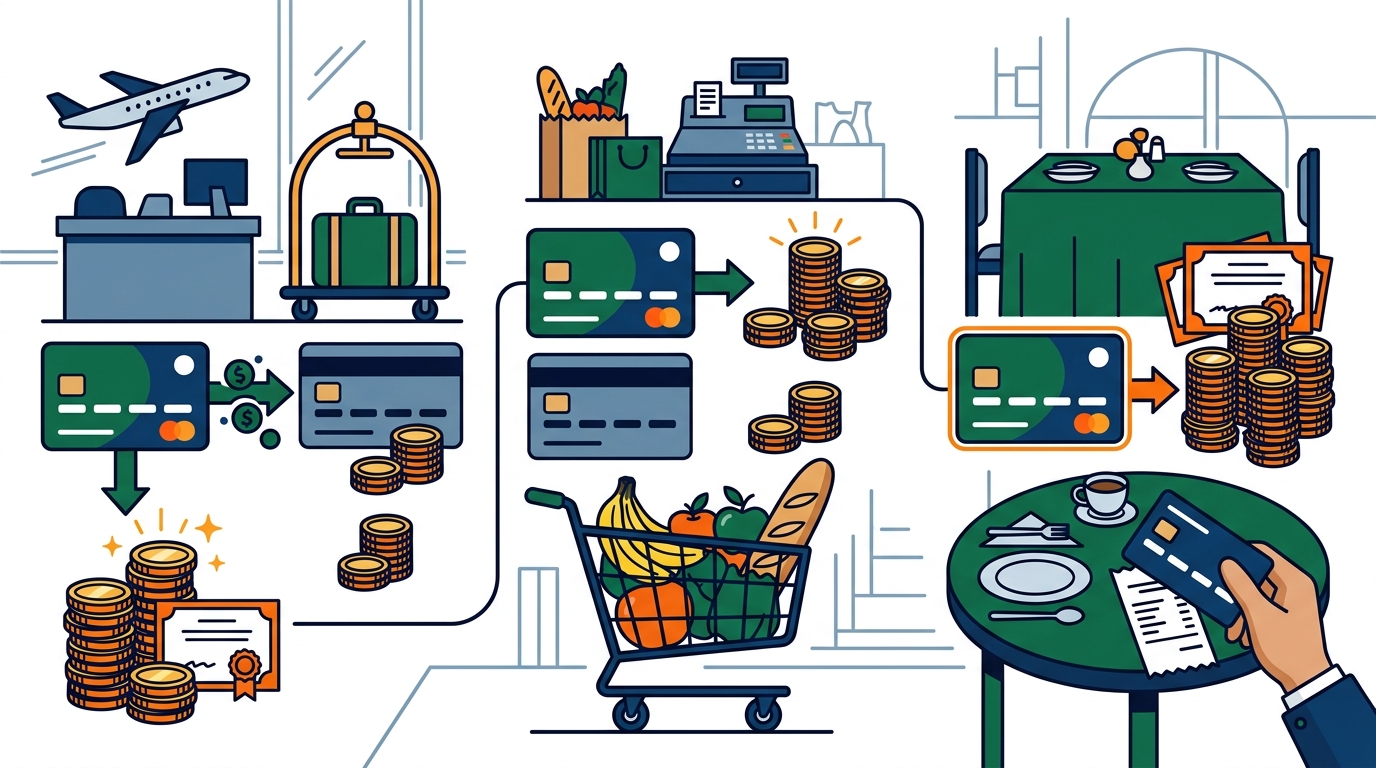
For most people, dining and travel represent the largest discretionary spending. Cards in this category often offer 3 to 5 percent back. Some premium travel cards offer 5 percent on flights booked directly with airlines. Others provide 5 percent on hotels booked through their proprietary portals. These percentages compound quickly over a year.
According to consumer spending data, the average household spends over $10,000 annually on dining and entertainment. Capturing 3 percent on this spend yields $300 in free rewards. That is a significant annual return without changing your lifestyle.
Groceries and Gas
Groceries and gas are non-negotiable expenses. They happen weekly. Cards offering 4 to 6 percent on these categories are essential. Some cards rotate quarterly categories. You must activate these bonuses monthly to qualify. Missing a rotation means losing potential earnings.
Fixed-rate cards for groceries often cap at 4 percent. This is a safe baseline. However, rotating cards can offer 10 percent during specific promotional periods. Tracking these rotations requires effort. savvX simplifies this by highlighting current high-yield opportunities.
Online Shopping Portals
Before you buy anything online, check the retailer's shopping portal. These portals offer additional points on top of your credit card rewards. You can earn 5 to 10 percent back at major retailers. This is passive income that requires only a click.
Combining a shopping portal with a high-reward credit card creates a double-dip effect. You earn points from the retailer and points from the bank. This strategy is critical for maximizing value on large purchases.
Maximizing Earnings with savvX
While credit cards provide the foundation, savvX provides the acceleration. savvX is a platform designed to help users maximize their points and rewards across various ecosystems. It acts as a force multiplier for your existing credit card strategy.
The core function of savvX is to identify hidden value in your points. It analyzes current transfer bonuses and promotional rates. It tells you when to transfer points to an airline partner versus when to book through a portal. This real-time intelligence prevents you from devaluing your hard-earned points.
Using savvX requires a registration to access its full suite of tools. Once registered, you can link your accounts to track performance. The platform provides alerts for limited-time transfer bonuses. These bonuses can increase the value of your points by 25 to 50 percent.
For users who want to see the platform in action, a demo is available. This allows you to explore the interface before committing. The pricing structure is designed to be accessible for serious point earners.
Accessing the answers section provides community-driven insights. Users share strategies for specific redemptions. This collective intelligence is invaluable for complex travel bookings.
Card vs. Platform Comparison
Understanding how credit cards and optimization platforms like savvX work together is key. One provides the currency, the other provides the strategy.
| Feature | Credit Card Rewards | savvX Optimization |
|---|---|---|
| Primary Function | Earn points on spend | Maximize point value |
| Value Source | Fixed percentage or bonus categories | Transfer bonuses and market rates |
| Effort Required | Low (automatic) | Medium (monitoring and action) |
| Best For | Daily spending | High-value redemptions |
| Cost | Annual fee or interest | Subscription or free tier |
The table above illustrates the synergy. Your credit card earns the points. savvX ensures those points are worth the most when you redeem them. Without savvX, you might transfer points during a standard rate. With savvX, you wait for a 50 percent bonus. This difference can save hundreds of dollars on a single award ticket.
Key Takeaways
- Average Missed Rewards: Most consumers miss 1 to 2 percent of potential earnings by not optimizing.
- High-Yield Categories: Dining and travel often offer 3 to 5 percent back with the right cards.
- Double-Dipping: Combine shopping portals with credit cards for maximum earnings.
- Transfer Bonuses: savvX identifies times to transfer points for up to 50 percent more value.
- Platform Access: You can login to savvX to track your personalized opportunities.
- Community Insights: The answers section offers peer-reviewed strategies.
- Transparency: Review the disclaimer and sms terms for full platform details.
Frequently Asked Questions
What is the best credit card for beginners?
Beginners should start with a no-annual-fee card that offers 2 percent cash back on all purchases. This provides a simple baseline. Once you have built credit, you can add category-specific cards.
How do transfer bonuses work?
Transfer bonuses are temporary promotions where banks offer extra points when you transfer to an airline partner. For example, you might get 50 percent more miles. savvX tracks these demos and alerts.
Is savvX free to use?
Check the pricing page for current tiers. Some features may be free, while advanced analytics require a subscription.
Can I use savvX with any credit card?
Yes, savvX works with any card that earns transferable points. It does not require you to switch banks. It simply optimizes how you use your existing points.
How often should I check for new cards?
Check for new card offers annually. Banks frequently update their sign-up bonuses. A higher sign-up bonus can offset annual fees for the first year.
What is the difference between cash back and points?
Cash back is fixed value. Points are variable. Points can be worth more if redeemed for travel. savvX helps you find the highest value redemption path.
How do I register for savvX?
You can register directly on the website. The process is quick and secure.
Start Maximizing Your Points
Stop leaving money on the table. Your credit card is a tool, but you need the right strategy to wield it. Combine high-yield cards with the intelligence of savvX. Visit the registration page to begin. Explore the demo to see the platform in action. Optimize your spend today and watch your rewards grow.