

The average household misses $1,128 a year in rewards by using the wrong credit card, according to data from the Bureau of Labor Statistics (2024). This statistic highlights a massive, silent leak in personal finance that occurs at the most basic level: the checkout counter. Most consumers rely on muscle memory, pulling out the same card for every purchase regardless of the merchant or category. This habit ignores the complex ecosystem of bonus multipliers, annual fee credits, and sign-up bonuses that define modern credit card optimization. The solution is not to memorize every card's terms, but to use a tool that analyzes your real transactions and recommends the optimal card in real time. (SavvX See What Your)
The Problem With Muscle Memory
When you swipe a card at a grocery store, a gas pump, or an online retailer, you are making a financial decision. If that decision is based on convenience rather than calculation, you are leaving money on the table. The concept of a Smart Wallet is an optimized collection of credit cards tailored to your specific spending habits. Without a tool to guide you, maintaining this wallet manually is nearly impossible for the average user. (SavvX See What Your)
Consider the typical American credit card portfolio. Many users hold three to five cards, each with different earning structures. One card might offer 5% back on dining, while another offers 3% on groceries. A third might be a flat 2% cash-back card for everything else. If you use the 1% card for groceries, you are effectively paying a 2% penalty on that purchase compared to the optimal card. Over a year, these small discrepancies compound into thousands of dollars in lost value. (SavvX Demo Explore a)
The difficulty lies in the cognitive load. Remembering which card earns the most at which merchant requires constant mental tracking. This is where automated optimization tools become essential. They remove the guesswork by connecting to your bank account via secure, read-only APIs like Plaid, which is used by over 150 million consumers. This connection allows the tool to see your real spending patterns and match them against the best available cards. (Answers SavvX)
How Real-Time Optimization Works
Real-time optimization tools function by bridging the gap between your static bank data and dynamic credit card offers. The process begins with a secure connection to your financial institutions. Unlike traditional apps that ask you to manually input your spending categories, these tools read your actual transaction history. This ensures that the analysis is based on reality, not projections or user estimates.
Once the data is ingested, the engine runs a complex algorithm. It evaluates every transaction against the terms of every card in your portfolio. It looks for missed activations, such as rotating category bonuses that require manual enrollment. It identifies dead credits, where you are paying an annual fee but not using the associated statement credits. Finally, it calculates the net value of each card after fees are subtracted from rewards and benefits.
This analysis reveals your "gap." The gap is the difference between what you are currently earning and what you could be earning with an optimized wallet. For example, if you spend $325 a month on dining and use a basic 1% card, you are earning $39 a month. If you switched to a card that offers 4% on dining, you would earn $13 a month more. Over a year, that is $120 in free money. The tool identifies these opportunities and presents them as actionable steps.
The output is not just a list of cards, but a ranked strategy. It tells you exactly which card to use for your next purchase. This eliminates the need for manual tracking and ensures that every dollar spent works harder for you. The goal is to close the gap entirely, turning your credit card usage into a passive income stream rather than a debt trap.
The Smart Wallet Framework
A Smart Wallet is not a single product, but a dynamic configuration of credit cards that evolves with your spending. The framework relies on three core principles: category matching, fee netting, and redemption flexibility. Each principle must be evaluated against your real data to determine its validity.
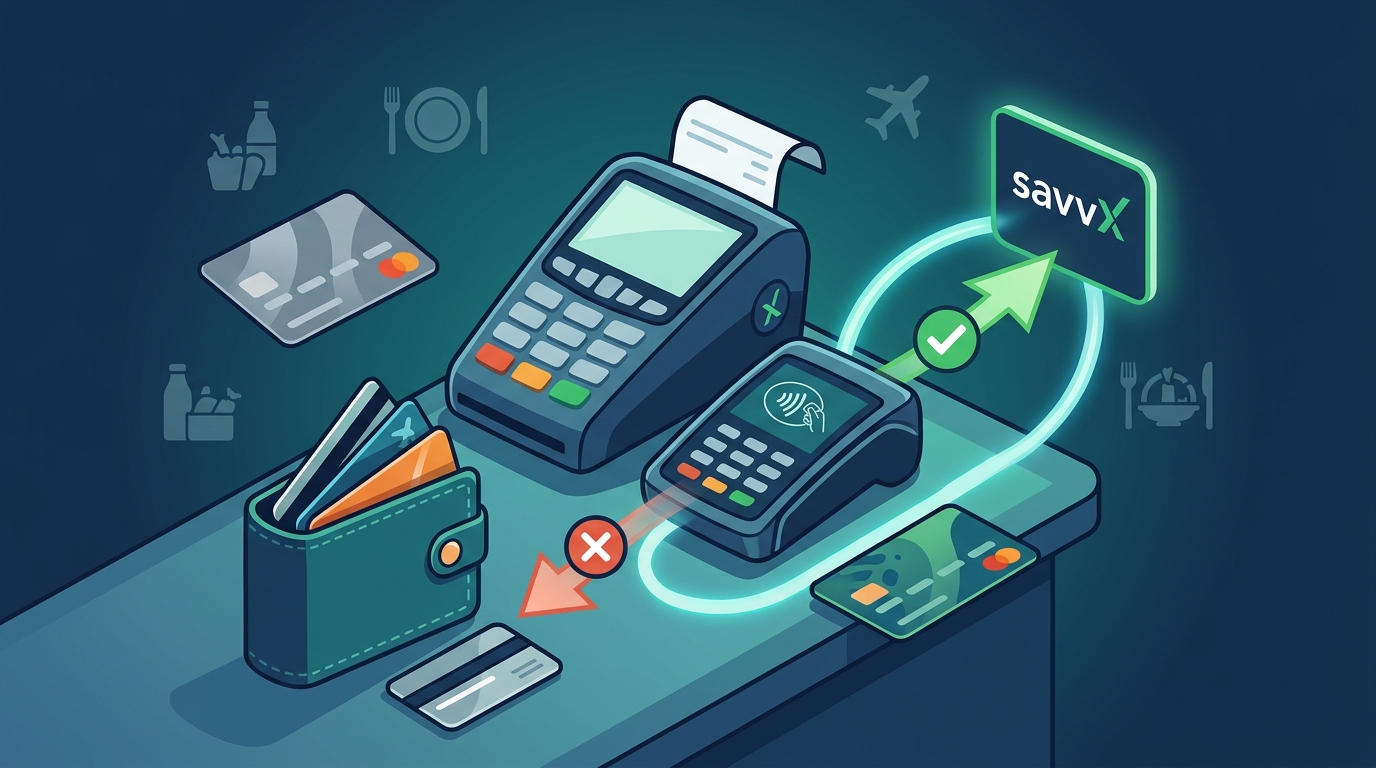
Category matching is the most immediate lever. It involves assigning specific cards to specific merchant categories. For instance, a travel card might offer 5x points on flights, while a grocery card offers 4x points on supermarkets. By using the correct card for each transaction, you maximize the base earn rate. This is where a checkout recommendation tool shines, as it can instantly identify the best card for the current merchant.
Fee netting is the second pillar. Many premium cards have annual fees ranging from $95 to $695. To justify these fees, the card must provide value that exceeds the cost. This value comes from statement credits, lounge access, travel insurance, and bonus points. A robust optimization tool calculates the net value by subtracting the annual fee from the total rewards and credits you actually use. If the result is negative, the tool will recommend downgrading or closing the card.
Redemption flexibility is the final component. Not all points are created equal. Transferable points, such as those from American Express Membership Rewards or Chase Ultimate Rewards, can often be transferred to airline and hotel partners for values exceeding 2 cents per point. Cash back is simpler but typically capped at 1 cent per dollar. The Smart Wallet framework prioritizes cards that offer transferable points for users who are willing to manage redemptions, while offering flat cash-back options for those who prefer simplicity.
Comparing Optimization Methods
There are several ways to approach credit card optimization. Each method has different levels of accuracy, effort, and potential return. The table below compares the most common approaches.
| Method | Accuracy | Effort Required | Annual Value Potential |
|---|---|---|---|
| Muscle Memory | Low | None | $0 - $200 |
| Manual Tracking | Medium | High | $500 - $1,000 |
| Quiz-Based Apps | Medium | Low | $800 - $1,200 |
| Real-Time Optimization | High | Low | $1,100+ |
Muscle memory yields the lowest return because it ignores category bonuses entirely. Manual tracking can be effective but is prone to human error and fatigue. Quiz-based apps offer a middle ground by asking you to input your spending habits, but they lack the precision of real transaction data. Real-time optimization, powered by tools like SavvX, provides the highest accuracy by analyzing your actual spending history. This method ensures that recommendations are based on what you actually buy, not what you think you buy.
The key differentiator is the data source. Quiz-based apps rely on self-reported data, which can be inaccurate. Real-time optimization uses bank-level data, which is immutable and precise. This allows for a more granular analysis of your spending. For example, it can distinguish between dining at a restaurant and buying groceries at a supermarket, even if both are processed through the same merchant category code. This level of detail is critical for maximizing rewards.
Key Takeaways
- The average U.S. household misses $1,128 a year in rewards by using the wrong credit card, according to BLS 2024 data.
- A Smart Wallet is an optimized collection of credit cards tailored to your specific spending habits.
- Real-time optimization tools use read-only APIs like Plaid to analyze your actual transaction history.
- Fee netting involves subtracting annual fees from rewards and credits to determine a card's true value.
- Transferable points can yield values over 2 cents per point when transferred to airline partners.
- Real-time optimization provides higher accuracy than quiz-based apps by using bank-level data.
- SavvX charges a subscription fee of $6.49 a month, with the first month free.
Frequently Asked Questions
Is there an app that tells me which credit card to use at checkout?
Yes, apps like SavvX connect to your bank account via Plaid to analyze your real transactions. It then recommends the optimal card for each purchase based on your specific spending patterns and card portfolio.
How can I maximize my credit card rewards based on my spending?
Maximizing rewards means matching every category of spend to the highest-earning card you can hold. SavvX shows your gap against an optimal wallet in dollars per year, identifying exactly where you are losing value.
How do I know if my credit card annual fee is worth it?
To determine if a fee is worth it, add the credits you actually redeem, the rewards earned on your real spend, and the benefits you claim. Subtract the annual fee. If the result is positive, the card is worth keeping. If negative, consider downgrading.
Should I cancel my unused credit cards?
Keep no-fee cards open by default to protect your credit history. Audit annual-fee cards each year against the credits and benefits you actually use. Close only when the math is clearly negative.
What is the difference between cash back and credit card points?
Cash back is simpler but has a value ceiling around 1 cent per dollar. Transferable points can hit 2+ cents through partners, but require active redemption and management of transfer ratios.
How does SavvX make money?
SavvX earns its revenue solely from user subscriptions. It does not accept affiliate links, bank kickbacks, or data sales. This ensures that its recommendations are unbiased and focused on your financial gain.
Can I earn enough credit card points for a vacation from everyday spending?
Usually not on its own, as organic earn is typically 60-100k points per year. Sign-up bonuses are the real lever for funding large purchases like vacations. SavvX helps you identify which bonuses you qualify for.
Start Optimizing Today
Stop leaving money on the table. The gap between your current rewards and your potential rewards is real, and it is measurable. SavvX provides the exact number from your real transactions, then closes the gap with an optimized wallet. Connect your cards securely through Plaid, see the leak category by category, and get the fixes ranked by dollars. Your first month is free, and if SavvX closes even the average household's gap, it pays for itself 14 times over. Get Started now to see your exact number in 20 seconds.